
Reading time 15 minutes
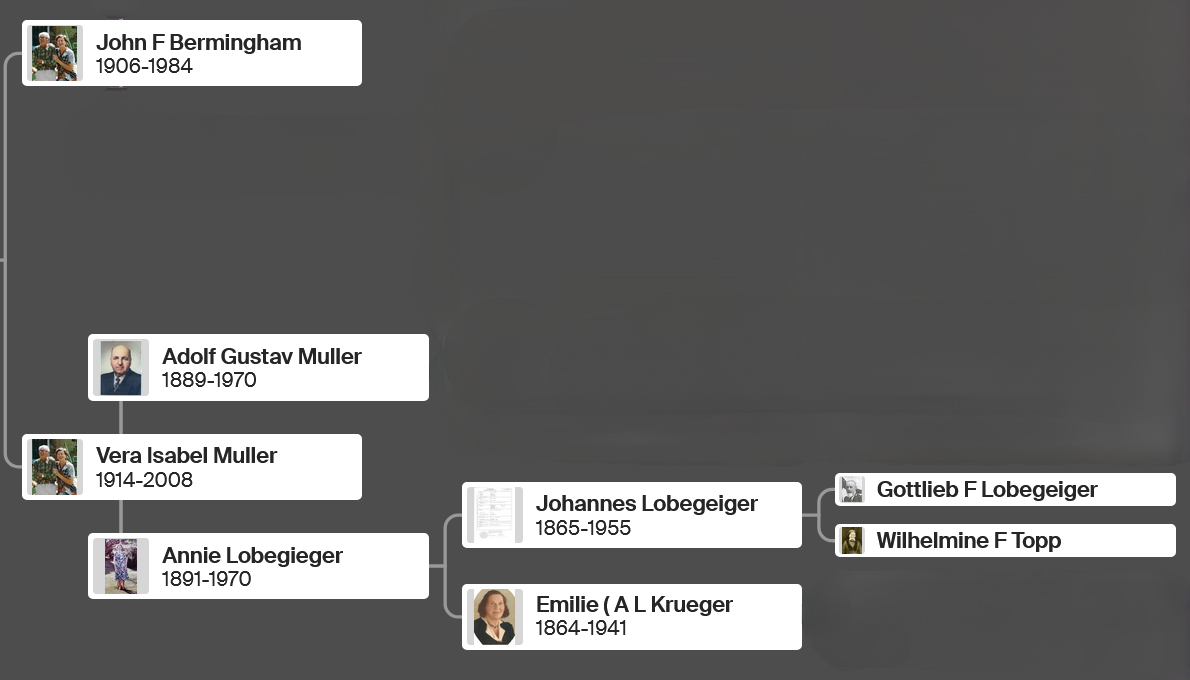
My great-great-grandfather, Gottlieb Friedrich Ferdinand Lobegeiger, was born in Templin, Brandenburg, Prussia, on November 3, 1826. His parents were Johann Friedrich & Friederike (nee Ihrke) Lobegeiger. My great-great-grandmother, Wilhelmine Fredericke Topp was born on December 28, 1827, also in Templin. Her parents were Carl Friedrich Topp & Sophia Friederika Weber.
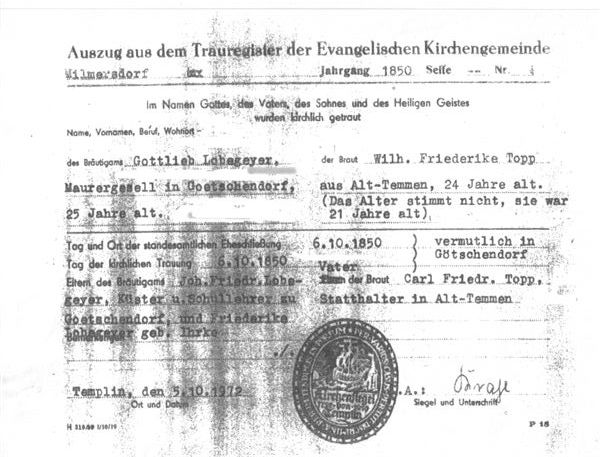
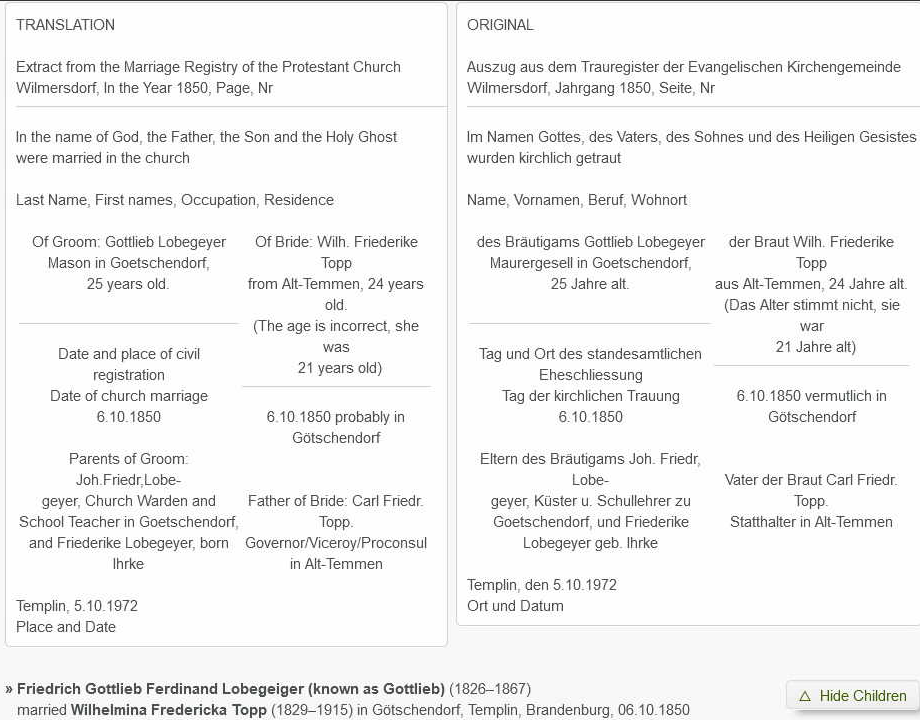
Gottlieb & Wilhelmine were married on October 6, 1850, in Templin, Brandenburg, Prussia, Germany. In many old German records, the family name is spelled Lobegeyer. When the spelling changed is unclear, but as with many old German names, the pronunciation and spelling were often modified upon arrival in English-speaking Australia. Record keepers and immigration officials frequently misspelled German names, which contributed to these changes.
I have mentioned in previous articles about my other German ancestors, on the reasons why they took the drastic action to leave their country and travel across the other side of the world. The Lobegeiger’s were no different. They got out of Germany because they had to. They wanted to give their kids a chance at a better life away from all insufferable conditions that German citizens were living under at the time. Life in Germany was pretty tough, with the Prussian government breathing down the necks of the citizens in every move they made in their day to day lives. Wars between the neighboring European nations was commonplace. Farm workers were being exploited & the situation showed no sign of improvement in the foreseeable future. So, a move by the Lobegeigers was urgently needed, to escape this dystopian existance.
When Queensland became a separate colony in 1859, the Herbert Ministry named a Select Committee to research the question of immigration, and J.D. Lang who was very much in favour of German Protestants, recommended the bringing out of a set number of them each year. To promote this, the Govemment appointed a Brisbane wine merchant, J.C. Heussler, as Immigrant Agent in Germany, and promised free passage and other advantages, with the result that by 1864 the number of Germans in Queensland had doubled. With what amounted to a pretty good list of options available to them, as immigrants to a new colony on the other side of the world, the family decided to get out of Germany & head to a country, that they knew very little about.
Gottlieb was aged 37 & Wilhelmine was 34 years old when they left Hamburg Germany on 21st September 1863 to travel to Australia on board the maiden voyage of the “Suzanne Goddefroy”. They had four daughters, Emilie (14), Willhelmine (9), Auguste (5) & Marie (2).
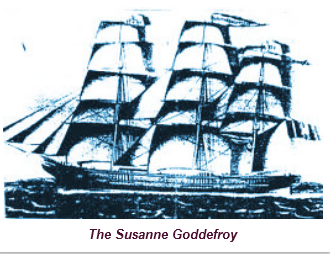
The ship struck some heavy weather on the way to Australia, which was fairly normal for most of the ships coming here. They sustained damages to the main mast that extended their time at sea, but still made it to Australia in 98 days. Its sister ship Wilhelmsburg had been lost on the journey with the loss of 282 lives, including 209 single men. After arriving at Cape Moreton the Susanne Goddefroy was boarded by Pilot Cooper, at 7.30pm, Sunday the 17th January 1864. She rounded the Cape and was brought up in the Roadstead off the bar the following day. The family arrived at Moreton Bay on the afternoon of the 18th January 1864. Of the 369 people on board, eleven children and one adult had died on the voyage from Germany.


The following morning, a steamer named the Settler took them up the Brisbane river where they disembarked at the South Brisbane Immigration depot at about 7am. They stayed there for a short period before moving to Pastor Gottfried Haussmann’s Lutheran Chapel at South Brisbane.
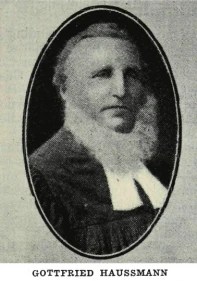
Pastor Hausmann helped many of the new German immigrants get established after their arrival in Queensland. Johann Gottfried Haussmann came to Queensland in 1838 among the Gossner missionaries who established German Station at Nundah. The son of a farmer, he had been taught various trades in preparaton for his missionary work. Hausmann had set up a chapel to prepare for his missionary work on the south side of Brisbane in 1862. He had visited the area around Bethania in the Logan district on many occasions, with a view to establishing a community with new German immigrants. The next step in the beginning of the settlement of the latest arrivals on the Suzzanne Goddefroy, was to move from Brisbane to Bethania, those who had selected land, and also those who intended to acquire land. The Lobegeigers fell into the latter category. To help convey their families together with luggage and stores to the Logan, the settlers, with the help of Pastor Haussmann, chartered the Diamond, a 56 ton paddle steamer with a shallow draft, to convey them down the Brisbane River, along the Bay, and then up the Logan. There were brief mentions in the shipping notes of the Courier and the Guardian that the Diamond left Raffs wharf early on the morning of 17 February 1864 to go to the Logan River with a party of Germans for a station there. There were 22 families, with a total of 98 persons on board. The trip was for an expected duration of two nights.

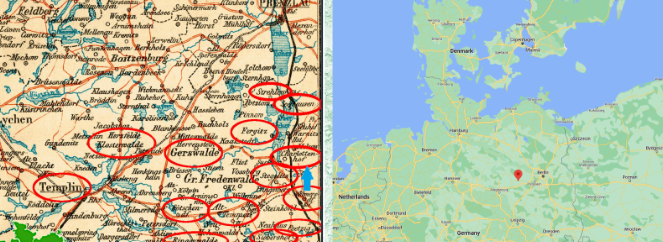
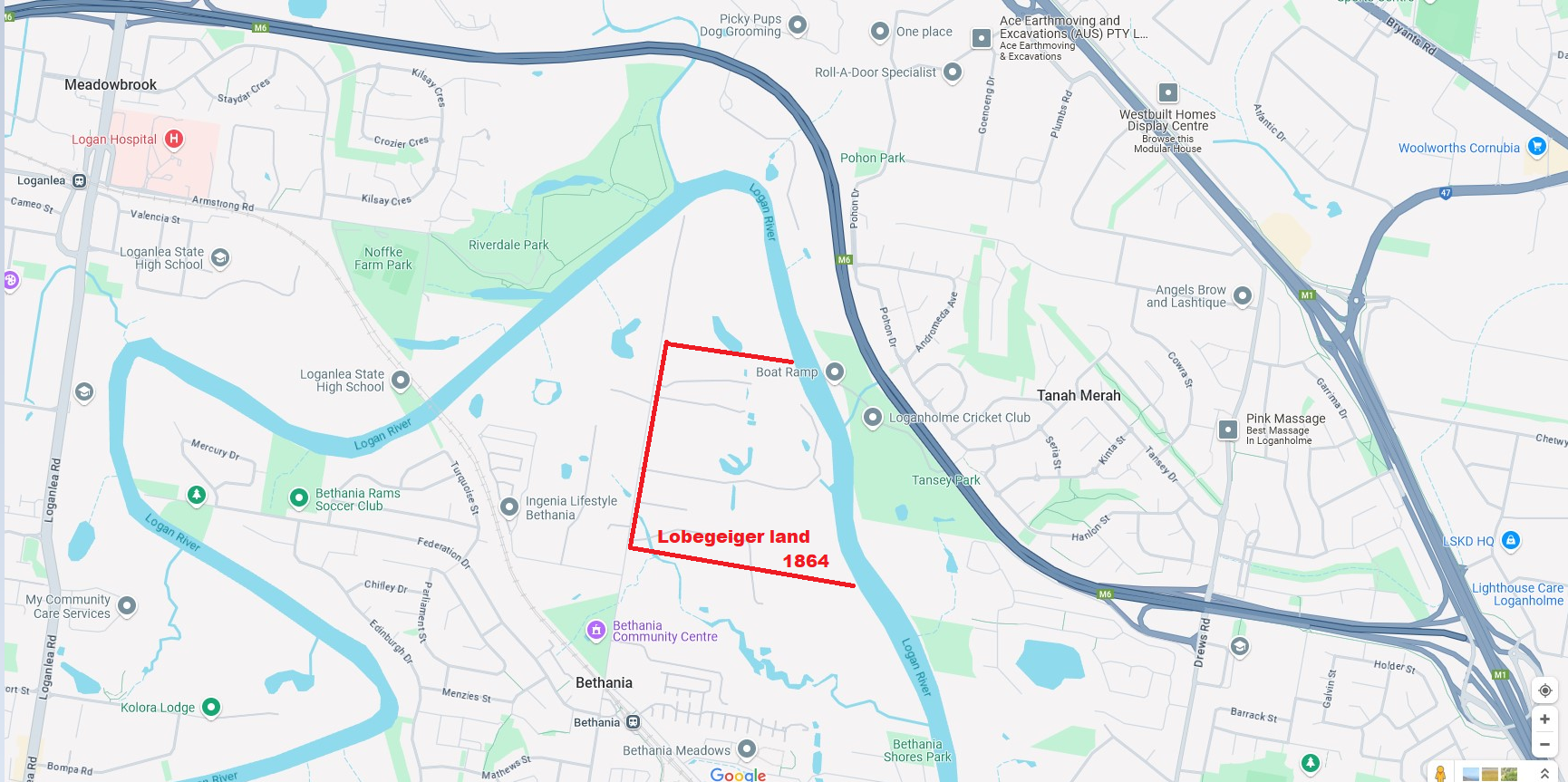
The settlers were landed on the bank at a bend of the river with deep water where Portion 26 can be seen on the map below. The approximate site is now marked by a memorial cairn erected in 1964.

Their first task was to erect shelter—a “greenhouse village” consisting of huts built from boughs and long grass. Gottlieb, Wilhelmine, and their four daughters—Emilie, Wilhelmine, Augusta, and Marie—faced many challenges in setting up shelter and adapting to the drastically different conditions they encountered. They quite literally stepped off the boat and were thrust into an alien environment upon arriving in Australia from Germany. At that time, there were still crocodiles in the Logan River, marking a stage of southeast Queensland’s history when the area was wild and untamed.
The new settlers would have been completely out of their comfort zone, struggling to adjust to the unfamiliar landscape. Various accounts describe heavy rain upon their landing. Although there were a few fine days, the rain soon commenced and continued. Flooding had occurred on February 10, and again on March 20. According to reports from The Brisbane Courier, heavy rain fell for three weeks, culminating in a gale that struck Brisbane on March 19, 1864. Both the Brisbane and Logan rivers flooded. On the Logan, punts were washed away, and crops planted by earlier settlers, including cotton, were destroyed.
Bethania was settled by the first 22 families, soon followed by another 14 families brought to the area by Pastor Haussmann. This group came to be known in the history of Bethania as “The Original Forty Families.” Problems arose due to poor land surveying, delaying the registration of land blocks. The Lobegeigers’ land was finally registered on October 10, 1866. Gottlieb’s portion was only about 8 acres, much smaller than he had hoped for. Pastor Haussmann, however, couldn’t be blamed for the small size of the portions, as he was merely trying to provide land for as many new German settlers as possible, allowing them to start farming and earn a living. Not all of the Forty Families stayed in Bethania; some remained for only a brief time.
On July 24, 1865, the Lobegeigers welcomed their only son (and Australian-born child), Johannes Lobegeiger, my great-grandfather, who was born at Bethania.
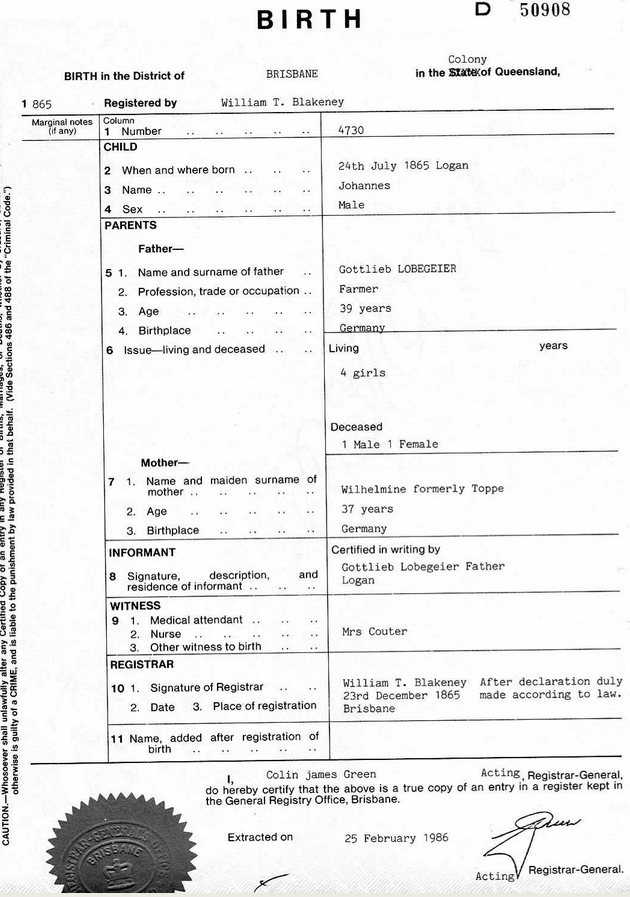
Shortly after Johannes’s birth, the family decided to leave Bethania. Eight acres were insufficient for Gottlieb to run a successful farm. Around August 1865, before their land in Bethania was even officially registered, they moved to the West Moreton area, between Ipswich and Peak Crossing. Like many European immigrants during that period, the Lobegeigers likely received land grants under the Crown Lands Alienation Act of 1860.
Check out this short video by Brisbane local historian Robert Braiden about the arrival of the Bethania Germans and the history of the suburb – https://www.youtube.com/watch?v=0LzrNObZBs8
An early map of the area when the Original Forty Families arrived is shown below, along with a current-day Google map of the location in the Logan City suburb of Bethania.

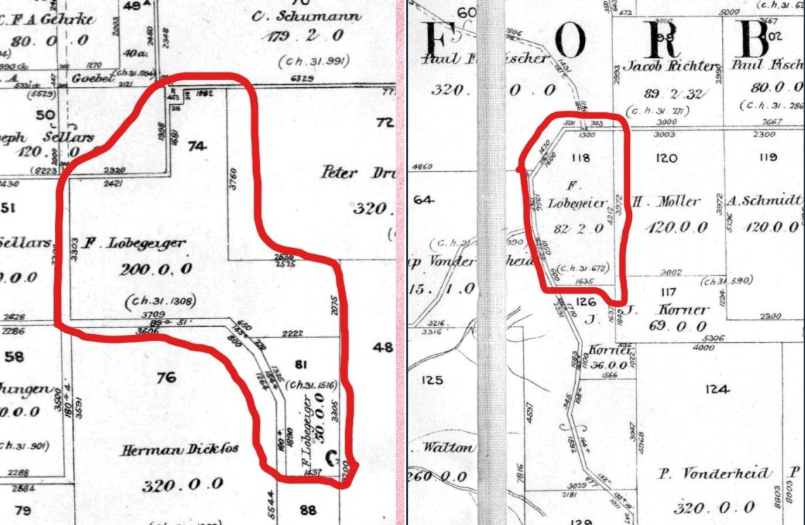
When the Ipswich Reserve was opened, many Germans from the Logan/Bethania area moved to farm on the larger blocks that were becoming available. This land had previously been part of thousands of hectares leased for station runs, controlled by families such as the Wienholts, Thorns and Kents, and was now being resumed by the government for farming selection. The rich black soil made it one of the most productive farming areas in southeast Queensland. By the end of the century, the number of farmers and their families who were German or of German descent living in the extended Ipswich Reserve, Fassifern Valley, and south of the Boonah districts was well into the thousands.
After building a dwelling, the next steps would have been clearing the land, erecting fences, and planting crops. The Lobegeigers likely grew a mix of market garden crops and grazed dairy and beef cattle on their property, beginning the process of becoming self-sufficient. Most farms in the area also had a chookpen &pigsty. The Lobegeigers even grew cotton for a short time during the American Civil War, when English mills were seeking alternative sources.
Just as things were beginning to improve for the Lobegeiger family, tragedy struck. They had been in Australia for a little over three years, and at Roadvale for less than two, when Gottlieb died of phthisis—a historical medical term commonly used to describe tuberculosis (TB), particularly when it affected the lungs. He passed away at the relatively young age of 42 on September 10, 1867.
At that time, TB immunization had not yet been introduced in Australia—it would not become available until the late 1940s—so without immediate medical intervention, the chances of survival were slim. Gottlieb was taken to Brisbane, where he died at a hospital on Leichhardt Street in Spring Hill.
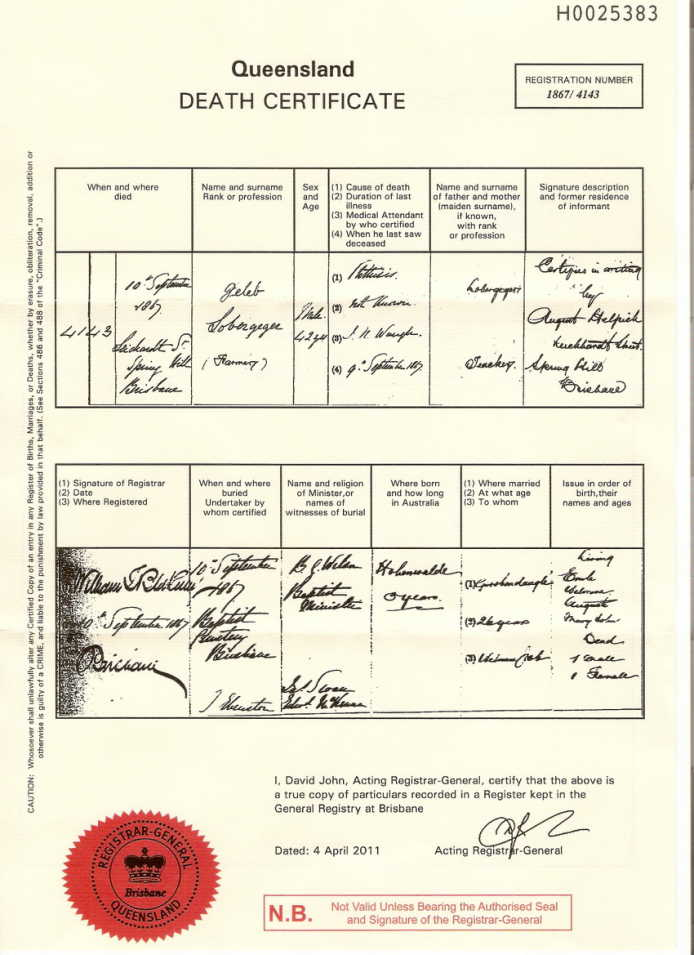
Most of the documents and records I’ve found list him with the names Gottlieb, Friedrich, or Ferdinand (in no particular order) as his Christian names. The Lobegeigers came from an ultra-conservative, centuries-old part of Prussia (Germany) and maintained their strict religious practices both before and after arriving in Australia.
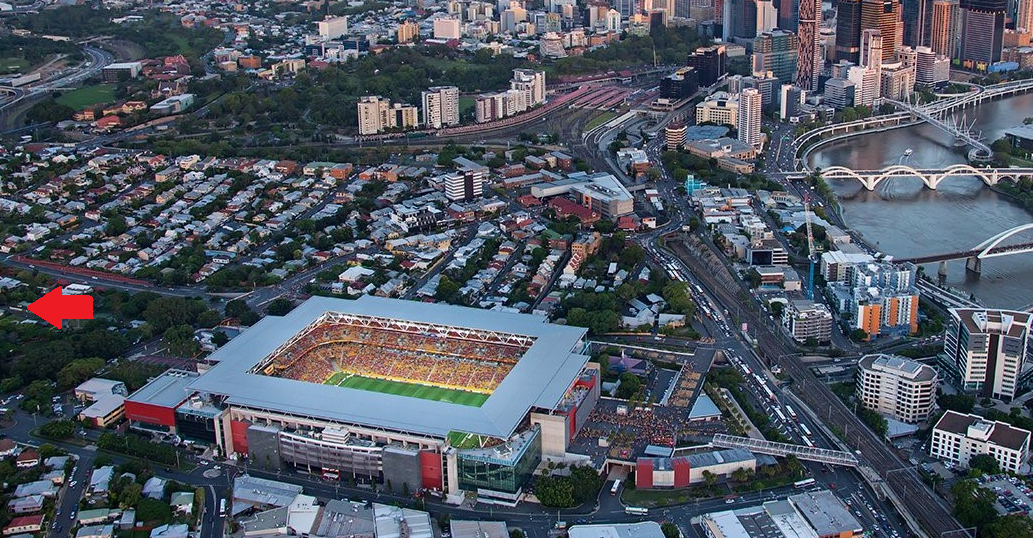
Gottlieb Lobegeiger was buried in the Baptist section of the Brisbane Cemetery, which at the time was located near where Lang Park stadium is now. By the early 1900s, the Brisbane General Cemetery had fallen into disrepair. The area had been flooded numerous times since it was established in 1844, and it was eventually proposed that the grounds be converted into a recreation reserve.
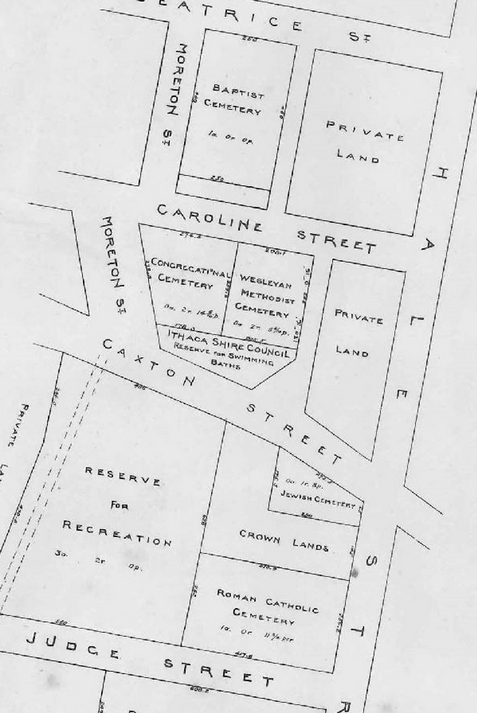
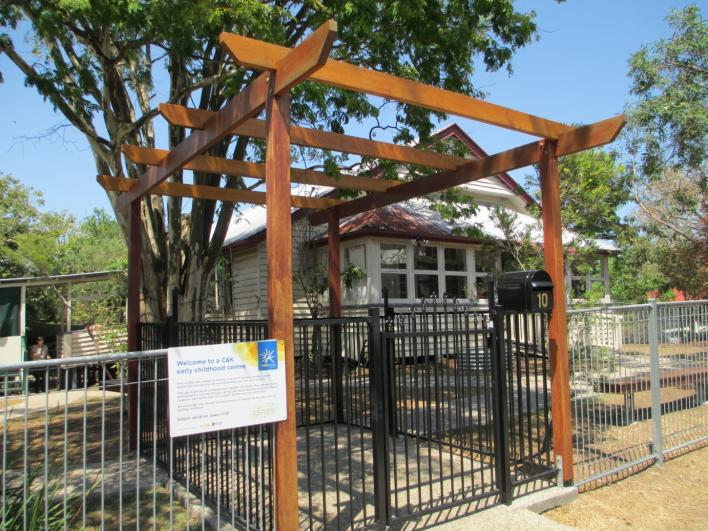
In 1911, the Queensland Parliament passed the Paddington Cemetery Act, authorizing the government to resume the cemetery and relocate the remains within 12 months. There was a token attempt to move the remains, with only 186 being shifted. Another 700 headstones and memorials were moved to other cemeteries around the Brisbane area. However, during the construction of the sporting reserve and park redevelopment in 1913, the majority of the 4,643 graves were simply covered over. The Baptist section, situated in the northern area where the current Paddington Kindergarten is located, adjacent to the stadium near Caxton Street, was left largely untouched. So, it is likely that the Baptists remain resting in peace where they were buried over a century and a half ago, now beneath the area where children at the C&K Child Care Centre play today.

For Wilhelmine and her four daughters, along with her 2-year-old son Johannes, the death of her husband, father, and main farm laborer would have mirrored the circumstances faced by many other families of the time. Farming practices in those early days involved numerous dangerous tasks, and many chores could result in serious injury. Farmers constantly handled large animals like horses, cattle, and pigs, which could kick or bolt unexpectedly if startled. Most of the grueling labor was done manually. They also had to contend with a variety of local animal and insect pests that were unfamiliar to them as former northern hemisphere farmers. Australia’s dangerous snakes were a significant problem in the Fassifern Valley, especially with extensive land clearing causing native animals to lose their habitats.
Accessing a hospital was another major challenge. In modern times, we take for granted that we can call 000 and have an ambulance with trained paramedics arrive shortly afterward. Such a luxury wasn’t available back then, and many people died before reaching a hospital. These difficulties meant that many early settler families experienced the loss of a family member, typically the father or husband. Serious injuries and fatalities due to farming accidents were fairly common and happened more often than most people realize. Besides the personal grief of losing a beloved family member, it also meant the family had lost their main laborer on the farm.
Life would have been especially difficult for a widow with a young family, with the oldest daughter, Emilie, being just 17. These pioneer women must have been incredibly resilient.
Most of the early landholders selected their land in the mid-1860s, and the larger landholdings were often the result of buying up neighbors’ properties. It was not unusual for partners to make initial selections, with one or both moving on to select independently further south in the 1870s, when Fassifern and Dugandan were opened up. Others expanded by maintaining their initial selection while taking up another property further south. Many of the Ipswich Reserve selectors obtained additional land in the newly opened areas of Fassifern.
The earlier Crown Lands Alienation Act of 1860 was upgraded with some additions in the 1868 version. Lands in settled districts that were not under pastoral lease became available for selection as agricultural or pastoral land. Section 14 allowed pastoralists to make pre-emptive selections of land from the pastoral lease at the rate of one acre for every ten shillings of improvements. Selectors paid annual rent to pay off the government-set price of the land. Agricultural land could be freeholded in three years if the required conditions were met and the remaining rent paid. In short, if you nominated a new land selection, made the necessary improvements within the allotted time, and turned a profit, you could expand your holdings relatively quickly. The Germans were well-organized and generally more educated in farming practices than many immigrants from England, Scotland, and Ireland, who were primarily farm laborers. German public education had been formalized in 1763 when Frederick the Great of Prussia mandated regular school attendance from the ages of 5 to 13 or 14.
Most Germans were fully literate upon arrival, only lacking English-speaking skills. The Fassifern Valley must have felt like a small corner of Prussia, with so many Germans arriving and diving into farming at the same time in the post-1870s period. Many current-day localities and landmarks in the district are named after German towns or the pioneers who settled there—e.g., Templin, Engelsburg Park, Wienholt Street, Muller Road, Wiss Street, Podlich Road, Berlin Road, Lobegeiger Road, Krueger Road, and more.
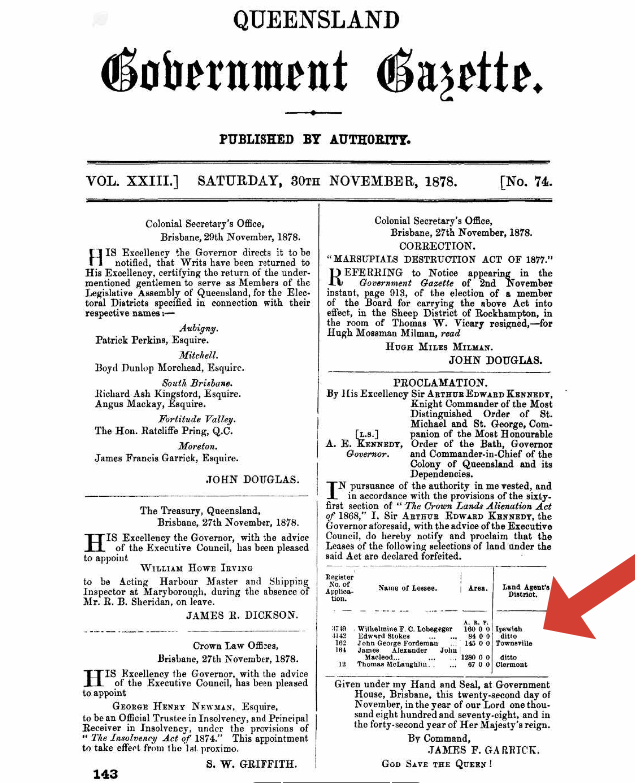
It appears Wilhelmine had to give up their initial landholding & the lease shortly after Gottlieb’s death. The Government Gazette dated 30 November 1878 shows the land being forfeited.
Great-great-grandmother Wilhelmine remarried on August 21, 1869, to Johann Heinrich “Henry” Schneider, who was also a recent widower. Henry came from a German family of stonemasons. He, his father, and his brothers had provided stonework for the Ipswich-Grandchester-Toowoomba rail line. Henry owned land at Rosevale, between Kalbar and Laidley. Both Henry and his father, Johann George Schneider, were Baptist pastors in the district. Henry’s first wife, Rosina, had died on January 4, 1869, from complications following the birth of their daughter Minnie, born two weeks earlier (December 23, 1868). Henry brought his five young daughters into the extended family—Fredericke Christine (6), Rosina Sophie (4), Christina Sophia (3), Louisa Fredericke (2), and Wilhelmine Minna (8 months).

I imagine the reality for Willhelmine after Gottlieb had died, was that she needed a male partner to help run the farm. Henry would’ve urgently needed a mother for his five young girls under 6, but it would have been a union born out of necessity. There were now nine girls in the family, with the oldest being Emilie Lobergeiger aged 19 and little Johannes being the only boy, aged 4 years old. Johannes & Henry would have been the only blokes in the family with 10 females to contend with. Willhelmine & Henry ended up having three more kids together, John, Martha & Henry jnr.
Queensland was going through a migration and population boom in the mid to late 1800’s. There was an increase in residents of over half a million, since becoming a colony in 1859. Farmers were in a great position to sell their produce to feed the fast growing rate of Queensland’s population, & the farmers in the south east region around Brisbane – Southern Moreton Bay, Beaudesert, Lockyer Valley & Fassifern Valley, were in the best location of all. The railway line to Harrisville opened in 1882, & on to Boonah & Dugandan in 1887, giving the local farming community much better access to the Ipswich & Brisbane produce markets. Sometime after her marriage to Henry Schneider in 1869, the family moved into the Fassifern Valley near Kalbar/Boonah.

Henry Schneider died on the 10th June 1905 at Kalbar, aged 68.
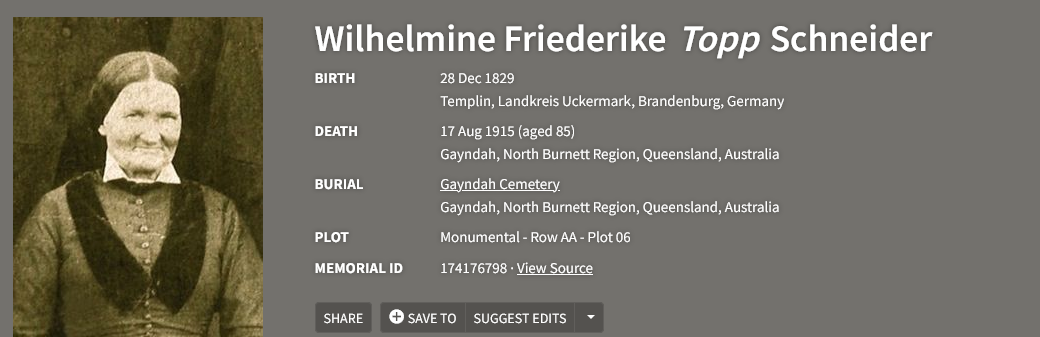
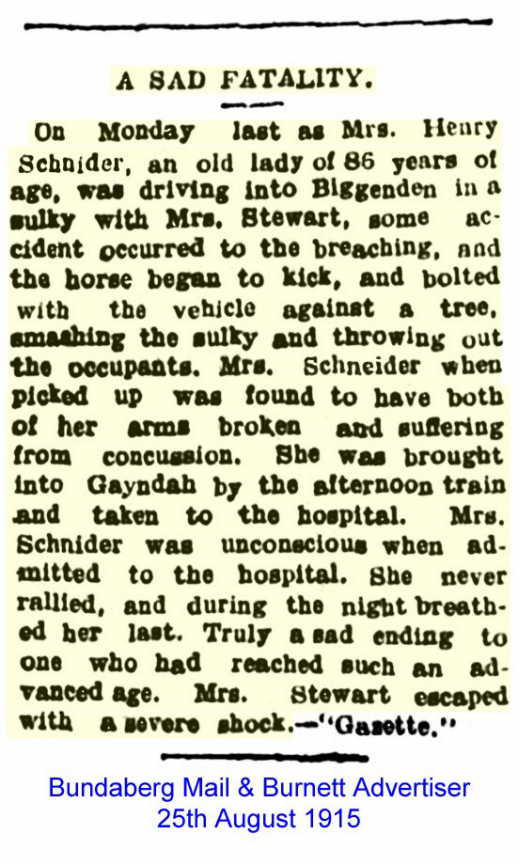
Wilhelmine had outlasted two husbands. She moved to Biggenden Queensland (85 klms west of Maryborough) to live with her daughter, Augusta Bertha Stewart & her husband Sam. She died in a tragic accident, while travelling home on the 17th August 1915, aged 86, and is buried in Gayndah cemetery.
They were a tough breed, these Germans who came to Australia 150 years ago to start a new life in a new country. Practically everything was against them. Gottlieb and Wilhelmine arrived in the Logan/Bethania district during flood conditions. They brought their five children to the Fassifern Scrub, where they began clearing and developing a farm. Gottlieb died less than two years after their arrival, leaving his widow with four young daughters and a baby son. Wilhelmine then had to take over running the farm.
They endured floods and droughts, constantly facing the harsh conditions of the land. The only thing working in their favor were the government acts in place to help farmers get started with food production. Some may view these acts as charitable, but the leaders of Queensland in 1859 knew they urgently needed a locally produced food supply. To achieve this quickly, they had to bring in as many experienced farmers as possible to meet the state’s growing demands. German immigrants, along with other nationalities, were the fast solution to this problem.
The other members of the Lobegeiger family—the four girls—all married and lived in Warwick, Boonah, Beaudesert, and Biggenden, Queensland. Gottleib & Wilhelmine Lobegeiger’s only son, Johannes (my great-grandfather), eventually took up farming, marrying Emilie Albertine Louisa Krueger, raising a family, and moving several times across southeast Queensland—from Fassifern to the Sunshine Coast, to Brisbane’s bayside, before finally settling near Beaudesert. His daughter, Annie Lobegeiger, married Alf Muller, who, to no one’s great surprise 🙂, was also a farmer with a German background, living in the valley. Alf and Annie Muller were my grandparents, and they, too, raised their family in the Fassifern Valley.


 porsche91722