
Reading time 17 minutes
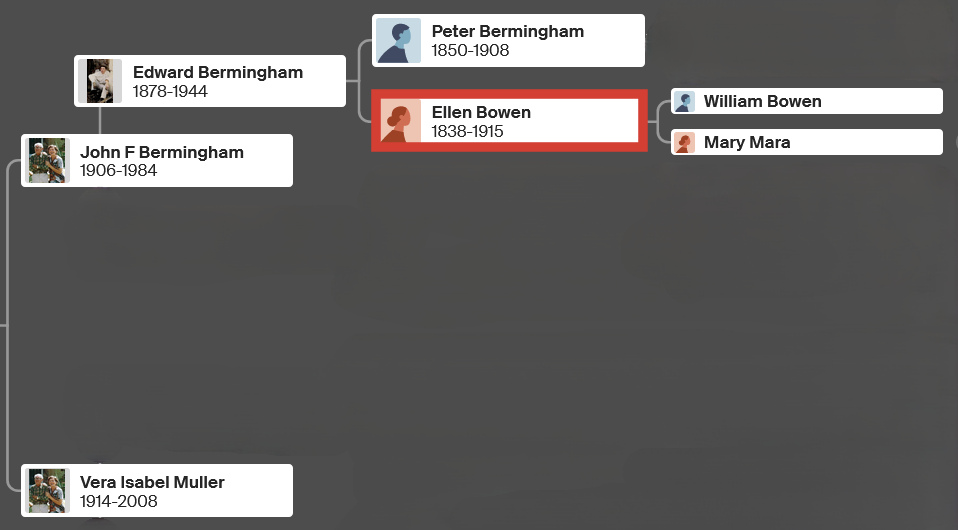
My Great Grandmother, Ellen Bermingham (Dunn / Bowen) was born in 1837 in Nenagh, Tipperary, Ireland to William and Mary (Mara) Bowen. Literacy was practically non-existent for the majority of the population in Ireland back then, so there are quite a few different spelling variations of my Great Great Grandmother Mary Mara’s maiden name. I’ve also seen the spelling of Mary’s name as Meara, Mera, O’Meara, O’Mara. It could be any of them. Ellen’s maiden name had many different misspellings over her life too, with Bohan, Bohen & Bohn being common. Ellen had a twin sister Julia and a younger brother Thomas.
Ireland was in a terrible mess in the 1840s. Life had always been an incredible struggle under the rule of the British, however the potato famine (1845- 1852) had taken the disastrous situation to another level. Nenagh and practically all of Ireland was hit hard by the famine, with the town and entire district descending into total poverty and starvation. English and Anglo-Irish families owned most of the land, and most Irish Catholics were relegated to work as tenant farmers & forced to pay rent to the landowners. Ireland was producing a surplus of food. However, between 1845 and 1852, more than 1.5 million Irish people starved to death, while massive quantities of food were being exported from their country to Britain. A half million people were evicted from their homes, often illegally and violently, during the potato blight.
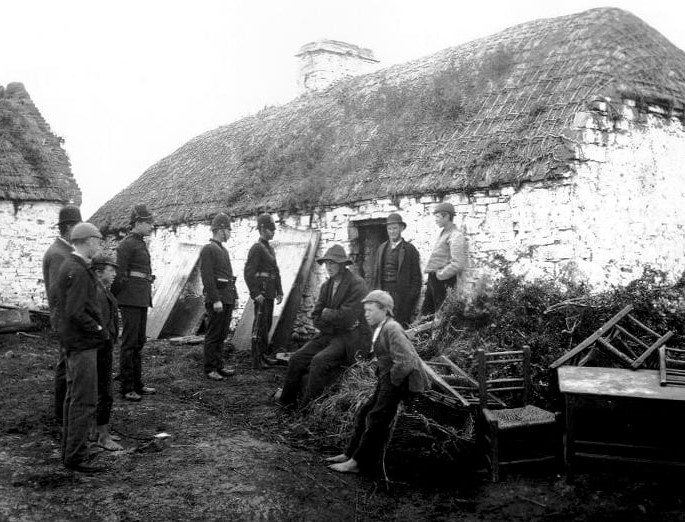
The immediate cause of the Famine was the very large population, living in miserable conditions and depending largely on the potato crop. The first reported appearance of the potato blight in the Nenagh Union was in the Nenagh Guardian of 15 October 1845. The potato crop failure in north-west Tipperary followed the same pattern as elsewhere – partial failure in 1845, almost total destruction in 1846 and 1847 and a gradual improvement in the crop returns for 1848 and 1849. The resultant loss of a high percentage of each year’s crop’s, meant a scarcity of seed for the following year. The potato shortage led to exorbitant prices for other foodstuffs such as oatmeal and Indian meal. The problem for the poor then was the lack of money to buy food. Between the years 1815 to 1845, over a million people had already left Ireland to escape the oppressive rule of the British, the civil unrest, the ravages of disease and epidemics, and the simple need to find a better life for themselves.
In Australia at that time of our history, Queensland hadn’t yet been declared as a state. It was still part of the colony of New South Wales. Government delegations from Queensland were sent to Ireland, England, and Germany, to enlist farmers, laborers, and skilled trades to migrate to Australia. Queensland was crying out for farmers to feed the growing population of the colony. There were great incentives for farmers and their families to come to Queensland. They had the opportunity to own tracts of land they could only ever dream about in Ireland. Many people in Ireland grabbed the chance to leave the misery behind at the earliest opportunity they could get. At least one million people left Ireland between 1845 and 1851. The volume of immigration in the post Famine period intensified and in the two decades of the 1850s and 1860s, about two and a half million more, fled Ireland bound for either the US, Canada, or Australia.
Ellen’s parents, William & Mary, had already made the move from Ireland to England, at some time during or after the famine. A distant relative in the UK, linked to the Bowen side of the family, Mrs Sheila Walker contacted me with some details of the family history –
In her words …………….“There was a story that came down the generations that William Bowen with his family came to England from Ireland bare footed -no shoes. The first recorded I have of them in the U.K. is 1861 census in Bradford but Ellen was not with them at that time. I have been to Liverpool and tried to find out about their crossing but nothing was found. I did find out the Catholic Church. It was very much involved in helping the Irish when arriving in the U.K. It’s 67 miles from Liverpool to Bradford I wonder how they got Bradford?
I know that the industry in Bradford at that time was weaving. A lot of people were employed in their homes with their own looms but later on they were made much wider looms, so they had to go into the factories for this kind of work. I know they stayed in Bradford for a number of years, but then the whole family moved down to Colin where they took up the same tradition of weaving. This was known as the industrial revolution at that time.”
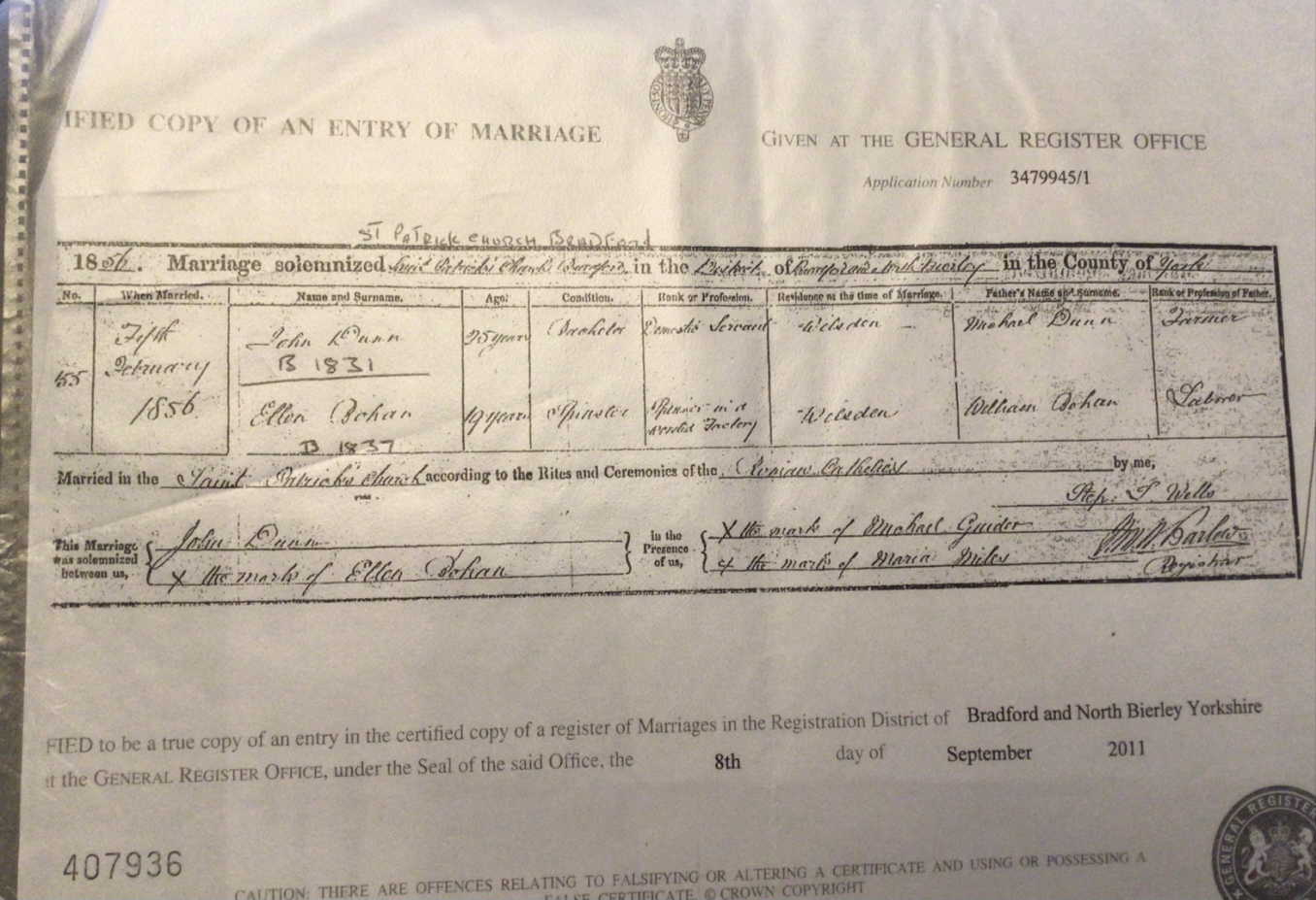
Ellen Bowen married Irishman John Dunn in St Patricks Church, Bradford, Yorkshire, England, on 5 February 1856, when she was 19 years old, not long after their arrival from Ireland. While this may be speculative, it seems the couple had long-standing plans to begin a new life together—far from the hardship and suffering that plagued both Ireland and England at the time. They made the decision to leave England almost immediately after marrying.
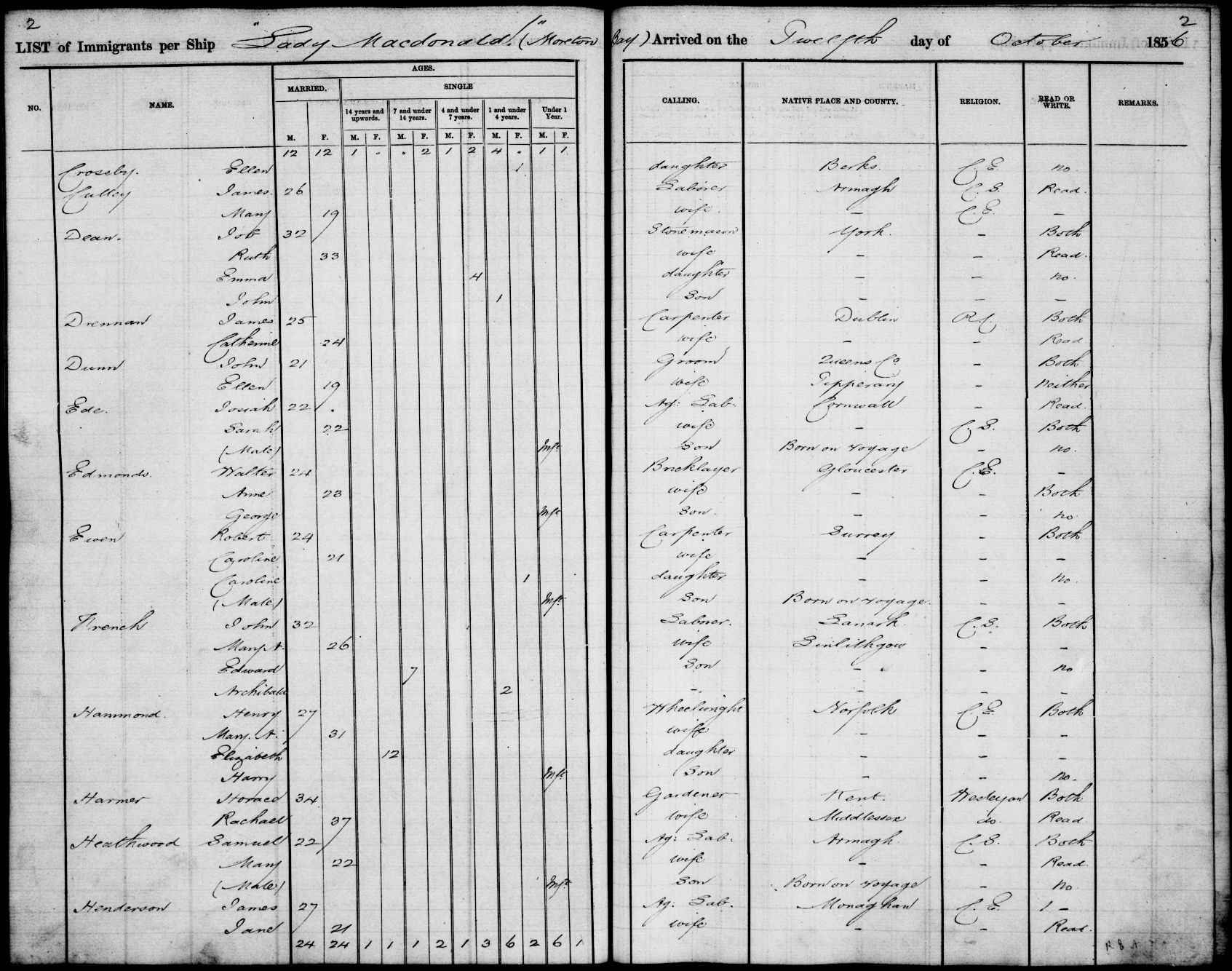
John and Ellen Dunn emigrated to Queensland, Australia on the “Lady McDonald” leaving the UK in June of 1856, & arriving in Moreton Bay on the 12th of October, 1856.
The couple’s first child, a daughter—Mary Ann Dunn—was born on 20 December 1856 in Brisbane, Queensland.
Ellen and John initially settled in the Brisbane area after their arrival from the UK. In 1857, they moved south to what is now the Gold Coast Hinterland, settling near Nerang Creek. At that time, the landscape of the Gold Coast was vastly different from today. While the golden sands of the coastal beaches would have been present, the modern glamour and high-rise apartments were still more than a century away. From approximately 100 metres inland to about 10 kilometres west of the coastline, the area consisted mostly of mosquito- and sandfly-infested swampland.
Ellen and John’s residence was likely near the base of the hinterland, roughly in the vicinity of present-day Nerang and Advancetown. After struggling to clear the dense scrubland, they likely decided to move to an area more hospitable and better suited to successful farming.
By the early 1850s, in response to increasing pressure from immigrants seeking land, the New South Wales Government began surveying and selling blocks of land for more intensive farming. By the mid-1850s, surveyors had reached the northern outskirts of Brisbane, identifying a district that became known as the Bald Hills Farms Subdivision. In 1857, while Ellen and John Dunn were still living at Nerang Creek, the first lots of agricultural land at Bald Hills were offered for sale. Many settlers claimed unallocated land and leased it, hoping to eventually secure permanent tenure.
Their son, John Bowen Dunn, was born on 20 September 1860 in Brisbane, Queensland.
After a losing battle against the harsh conditions at Nerang Creek—including difficult terrain, swarms of mosquitoes, adverse weather, and ongoing conflict with the local Indigenous people—the Dunn family undertook a 100-kilometre trek north in early 1863 to the Pine Rivers district, north of Brisbane. There, they took up farming under a lease arrangement at Bald Hills.
Their daughter, Ellen Catherine Dunn, was born in 1867 in Bald Hills, Queensland.
In 1868, a significant shift in settlement patterns began following the passage of the Crown Lands Alienation Act. This legislation mandated the resumption of at least half of the leased areas on large pastoral runs, making the land available for selection. The fertile regions in the southern part of the district began attracting renewed interest. Once the family had gained some financial stability at Bald Hills, they decided to relocate once more—this time with a longer-term plan in mind.
Their son, James Thomas Dunn, was born in 1868 at Bald Hills.
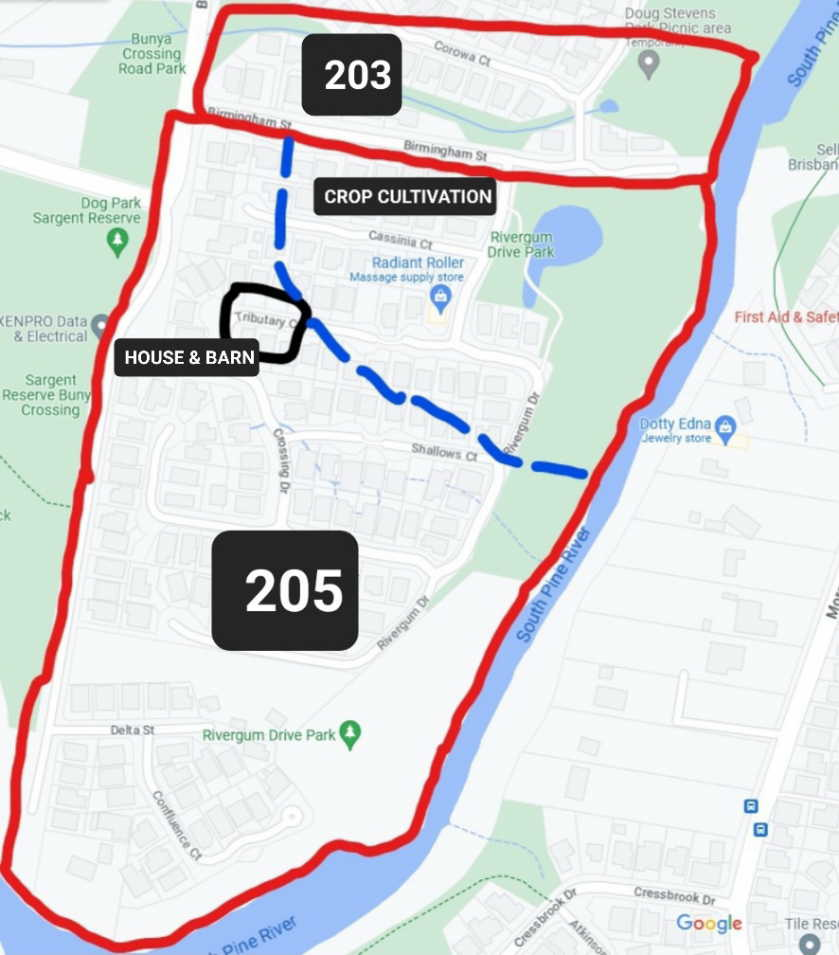
In 1869, Ellen and John leased a 40-acre selection of land along the South Pine River, where they began clearing the land and cultivating crops. Under the regulations for migrant families, they were required to make improvements to the property during the ten-year lease period, after which they would be eligible to purchase the land outright. This parcel is located in what is now the modern suburb of Eatons Hill.

Daughter – Julia Margaret Dunn born 30th August 1869 South Pine River Queensland.
Daughter – Margaret Jane Dunn born 30th August 1869 South Pine River Queensland.???? Got to check this- may be incorrect – No further records on a marriage, kids, death or burial. May have been a twin to Julia, died at birth.
There must have been some disputes going on between the neighbouring property owners, which came to a head on Saturday, March 25, 1871. Working the land and raising a family back in those days would have been tough enough, without having to contend with an ongoing disagreement with an aggressive neighbour. Being of Irish descent, Ellen would have had a fairly feisty temperament herself, and would not have taken a step back, when push came to shove. Keep in mind, Ellen certainly hadn’t forgotten about the life they had left behind in the old country. In Ireland, when existing to stay alive on a day-to-day basis was just the benchmark, a disagreement with an abusive and pushy neighbour was the least of her worries. Ellen may never have had much of a formal education, but she knew how to handle herself. Even though the government of the day, at that stage of Australia’s history, was still beholden to its British masters, there were more rights to a fair hearing when it came to illegal and violent attacks on citizens than what was previously available to her in Ireland. She took him to court and won.

Son – William Dunn born 2nd November 1874 South Pine River – died 16th May 1875 South Pine River Queensland
1875 was a terrible year for Ellen and the family. Her husband John died on the 15th of May at the relatively young age of 43, and baby William passed away the following day aged 6 months. It’s possible that they were involved in an accident that claimed both of their lives.
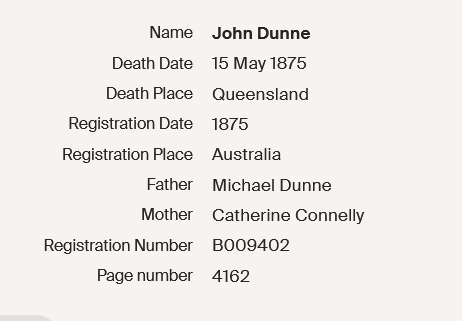

I haven’t been able to find any records detailing the cause of death for either of them. A mystery, still to be solved!
Following the double tragedy of losing both a husband and a baby, Ellen would have immediately realized that she urgently needed assistance to keep the farm going. She would have needed a capable farm hand, to help run the farm so it could remain functional. Prior to her husbands death, Ellen and John were still only about half way through the ten year lease on the property. There was a definite possibility that she could have lost everything and been totally destitute, with nowhere to live and five kids in her care. Even though she had been in Australia for nearly two decades, there was no family support network and probably only a few friends. The neighbour certainly wasn’t going to be of any help. Pioneer farmers were still just trying to get their heads above water and get their farms established. The shock loss of her husband, immediately followed by the tragic death of their youngest child would have been heartbreaking and life changing. Back, at that point in time, if a widowed woman was unable to provide for her family, the kids were often forcibly removed and placed into State care. If the family unit was to remain intact, Ellen needed help, quickly. Ellen’s children were aged 15, 8, 7, 6 & 5 years old.
During the second half of 1875, Peter Bermingham arrived on the farm at South Pine. He had immigrated from Carbury Kildare Ireland, arriving in Maryborough (250 km north of the South Pine River) in October 1874. Peter was an Irish Catholic farm laborer, who was looking for gainful employment. Ellen urgently required assistance to run the farm, so she would have jumped at the chance to get someone into the job as soon as possible. His primary roles on the farm would have been to look after crop farming, cattle grazing, transportation of produce & stock to the transport hub/markets, and general maintenance on the property.
Without stating the bleeding obvious, I have come to the distinct conclusion, that Peter the farm labourer, may have been romantically involved with his employer Ellen, at the time. She fell pregnant, and with both being devout Catholics, marriage was the one and only option.
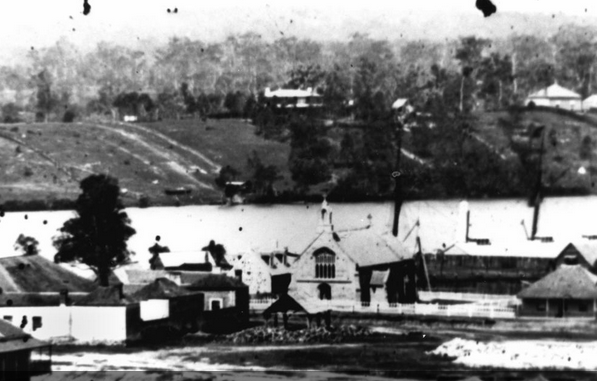
Peter and Ellen Bermingham were married on 22nd May 1877, at St Stephens Cathedral in Brisbane.
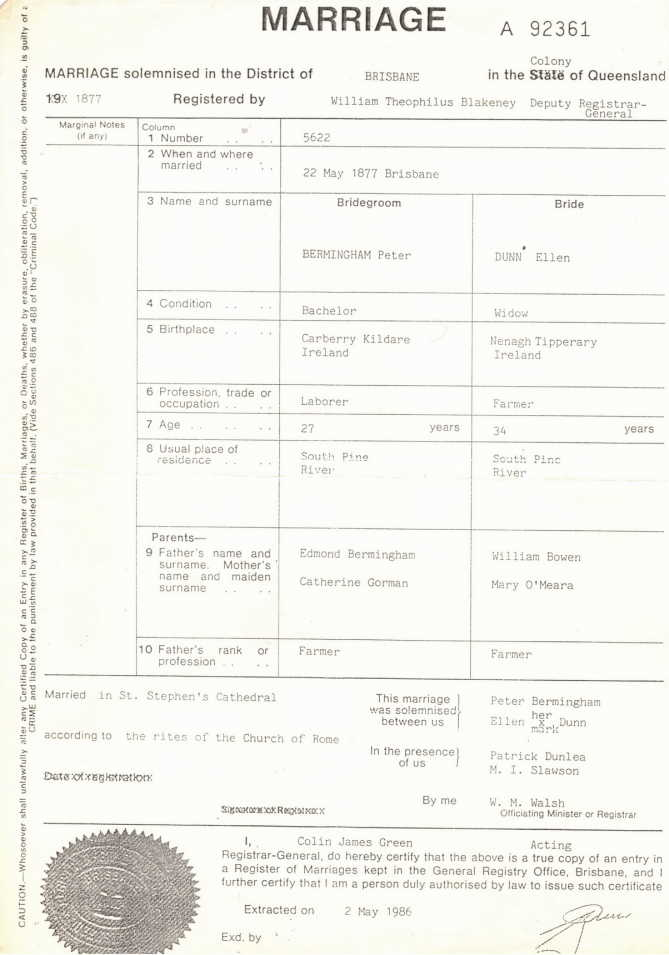
Son – Edward Bermingham born 17th January 1878 South Pine River.
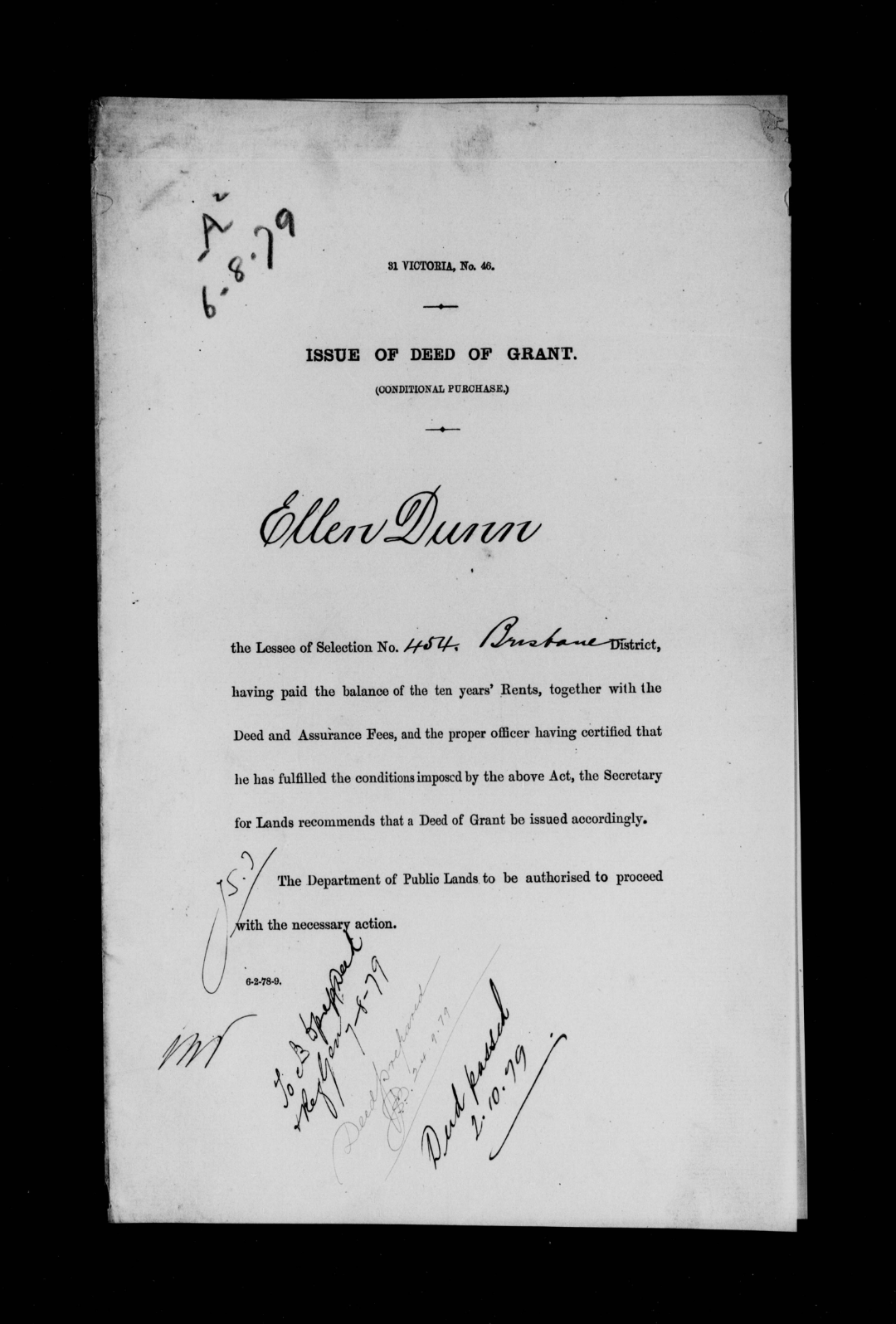
Following her first husband John’s death, Ellen applied for transfer of the farm and finally received sole ownership in her name on 10th July 1879. Interestingly, following their marriage, Peter’s name was never included in the land deeds.
Ellen may have had second thoughts about the prospect of her new husband, Peter Bermingham—a farmhand—gaining access to her land ownership. At that point in Queensland’s history, while there were plenty of female landholders, the vast majority of land was still owned by men. Legal equality for women remained a distant goal. It was likely only due to her status as a widow that she was able to secure the land deeds in her own name without contest.
As mentioned, she may have become increasingly uneasy about the possibility of her new husband acquiring control of the property. Ellen, however, was undoubtedly astute and resourceful. She had the foresight to stay one step ahead, and it’s clear that no one was going to take advantage of her.
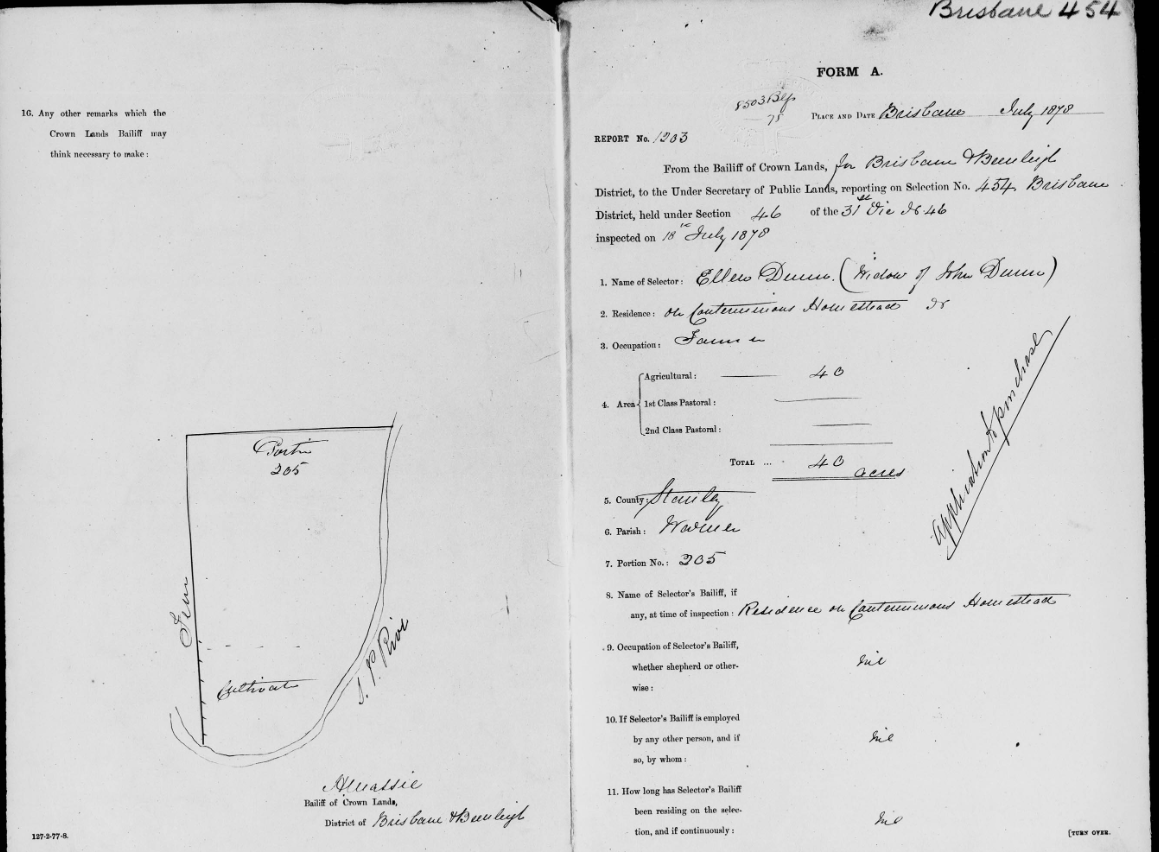
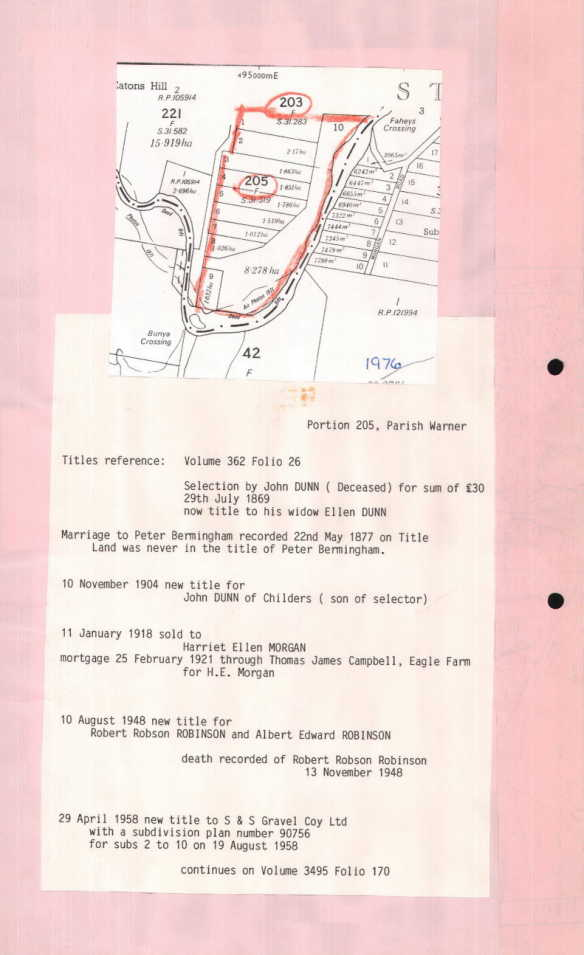

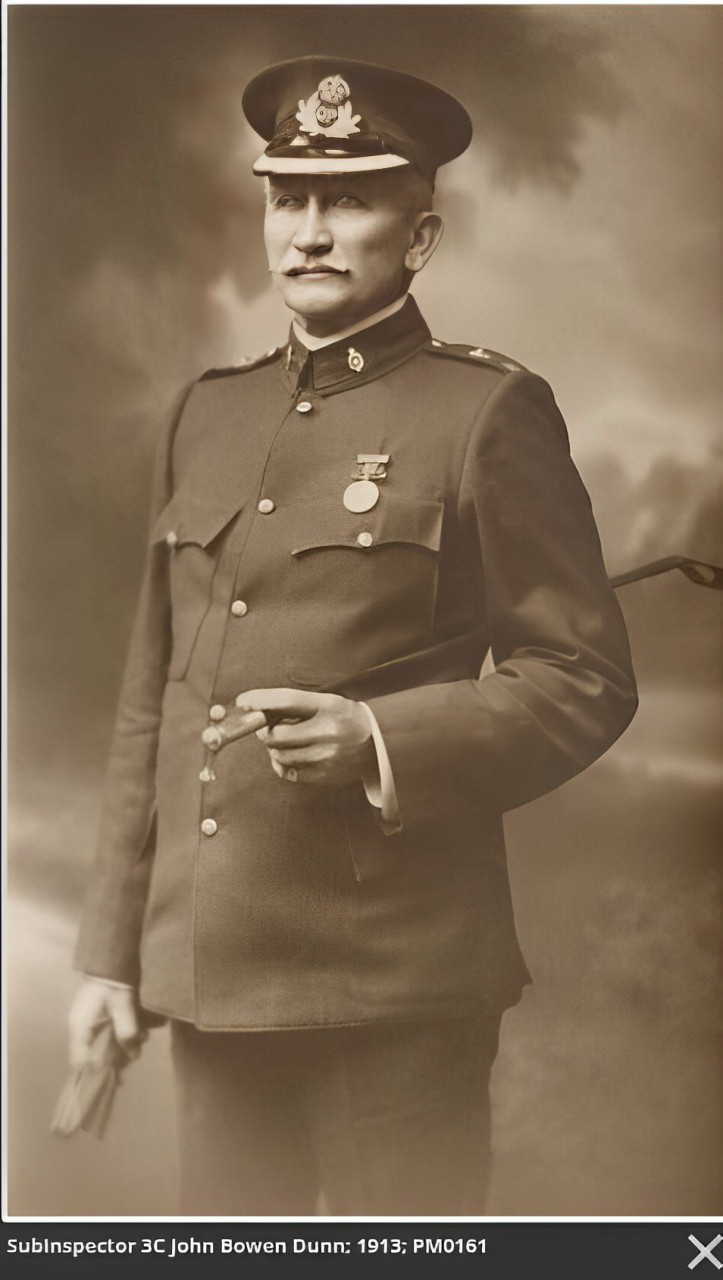
There is a slight possibility that Peter Bermingham may have had a checkered past. By 1881, Ellen’s oldest son, John Dunn Jnr had become a police officer. His full name was JOHN BOWEN DUNN, with his middle name being Ellen’s original maiden name – Bowen.
By 1881, the Dunn children – Mary Ann(25), John Bowen(21), Ellen Catherine(14), James Thomas(13) & Julia Margaret(12) may have been protecting their mother by pushing Peter out of the family circle. Baby Edward, would still have been only three years old. It happens in a lot of cases where the mother remarries shortly after the death of her husband, and the children for one reason or another, take an instant dislike of the new guy. I believe this may have been the case here. As he got older, Edward didn’t even appear to be close to his biological father, Peter Bermingham, and remained in closer contact with his mother and his Dunn siblings. Sadly, my Great Grandfather Peter Bermingham, appears to have been shunted by the family, with few records of his existence after the marriage, other than a couple of notes on the land ownership documents. The man may have been completely legitimate; however, there are no media reports, no record of foul play, no death certificate, no documents of his place or date of death, or a burial record. There is just one short mention at the bottom of Ellen’s obituary notice from the Brisbane Courier Mail, 3rd January 1916, of his passing in approximately 1909. It seems that Peter Bermingham disappeared without a trace.
Ellen and Peter Bermingham’s nine-year-old son Edward followed his half-brother & his wife, Martha to Boonah, after Senior Constable John Bowen Dunn was posted as the town’s first police officer in 1887.
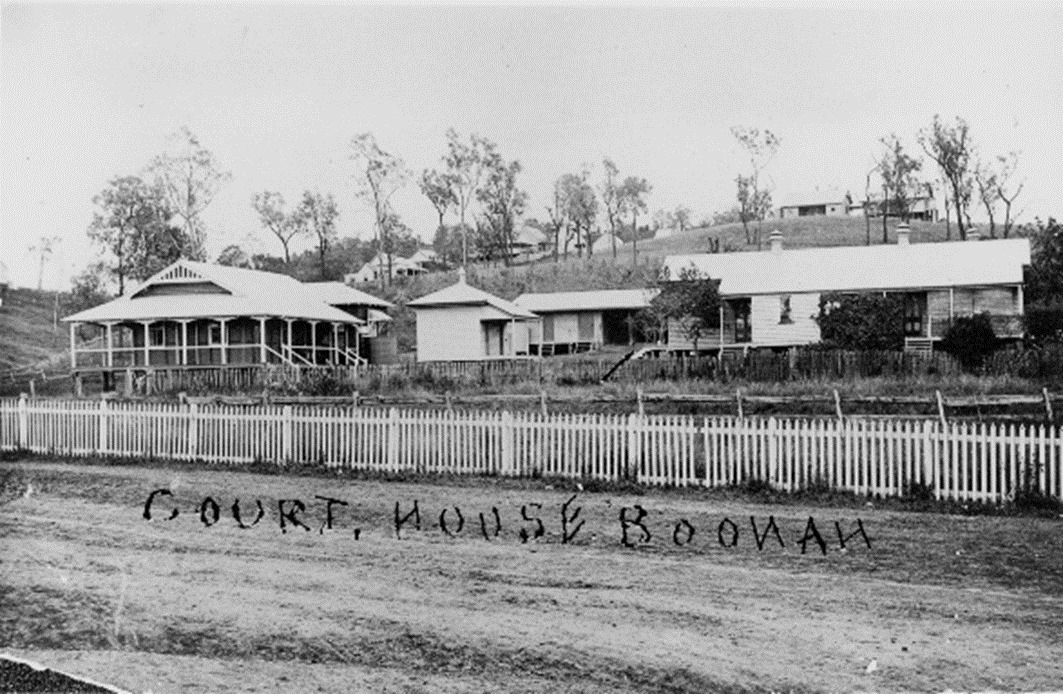
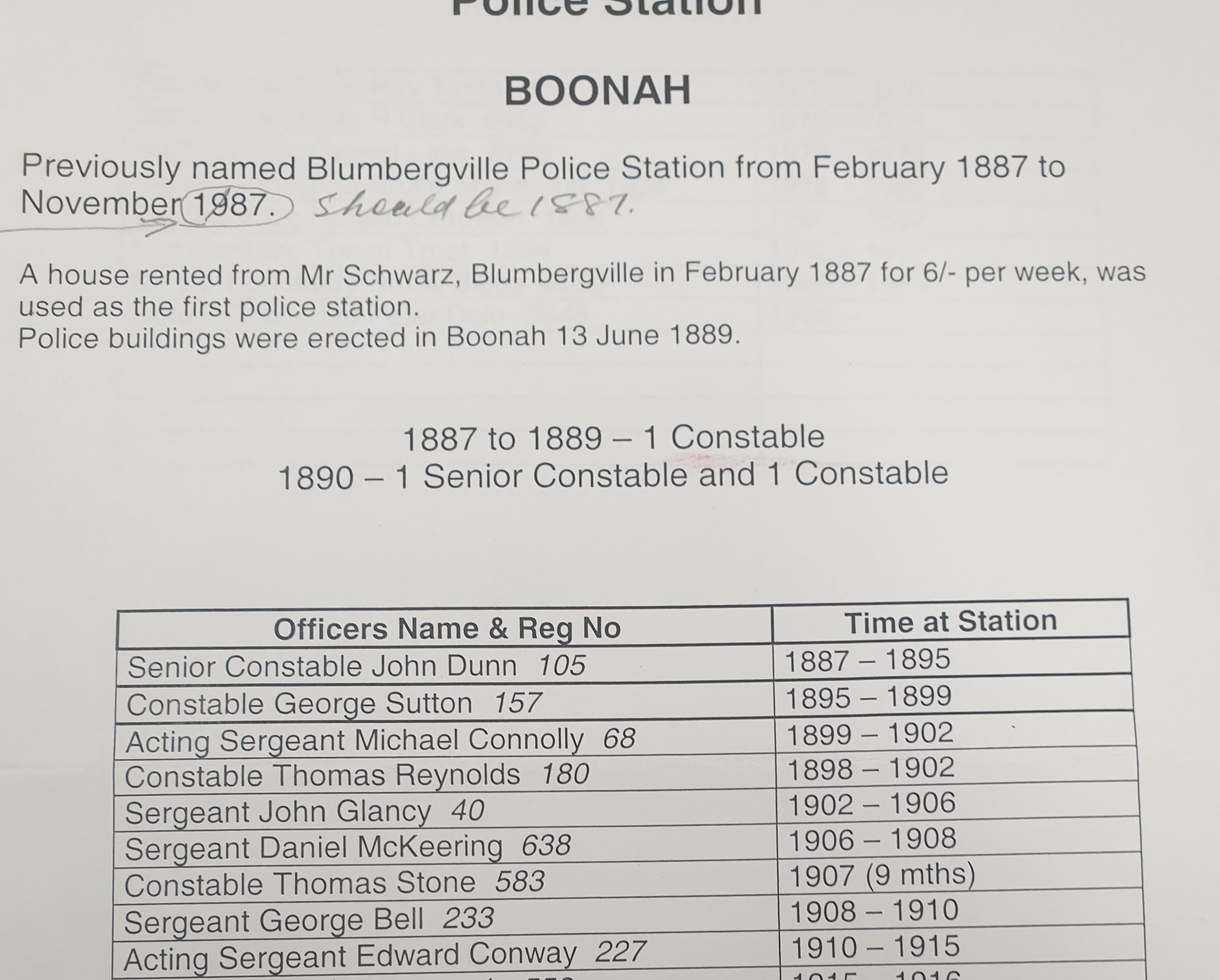
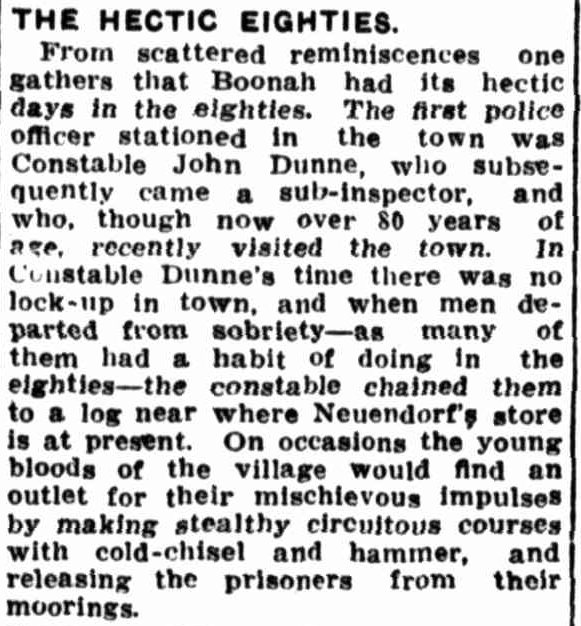
John & Martha Dunn never had any kids of their own. After leaving his parents’ farm at South Pine River in 1888, nine-year-old Edward (Ned) Bermingham lived with John & Martha Dunn at the Boonah Police Station & attended Boonah Primary & Rural schools. On completing his education, Ned went on to take up a trade, working as a cabinet maker/carpenter around the Boonah/Fassifern Valley area for the rest of his life. On 12-10-1903, Ned married a local girl from the Fassifern Valley, Catherine Mary Corcoran. They later had a son John Francis Bermingham (born 1906), who was my father. I believe my Dad was named John, as a sign of respect that Ned had for his older brother. Constable John Bowen Dunn was 18 years older than Ned & became more of a father figure to him than his own Dad – Peter Bermingham. John Bowen Dunn played a major role in Ned’s upbringing, particularly during his teenage years, growing up in Boonah. We still have memorabilia (service medals etc) in the family from Sub-Inspector 3rd class John Bowen Dunn’s police career. Remembering back to my own childhood, I can never recall my great-grandfather, Peter Bermingham’s name ever being mentioned. I didn’t even know that he existed until the interest in my ancestors began.

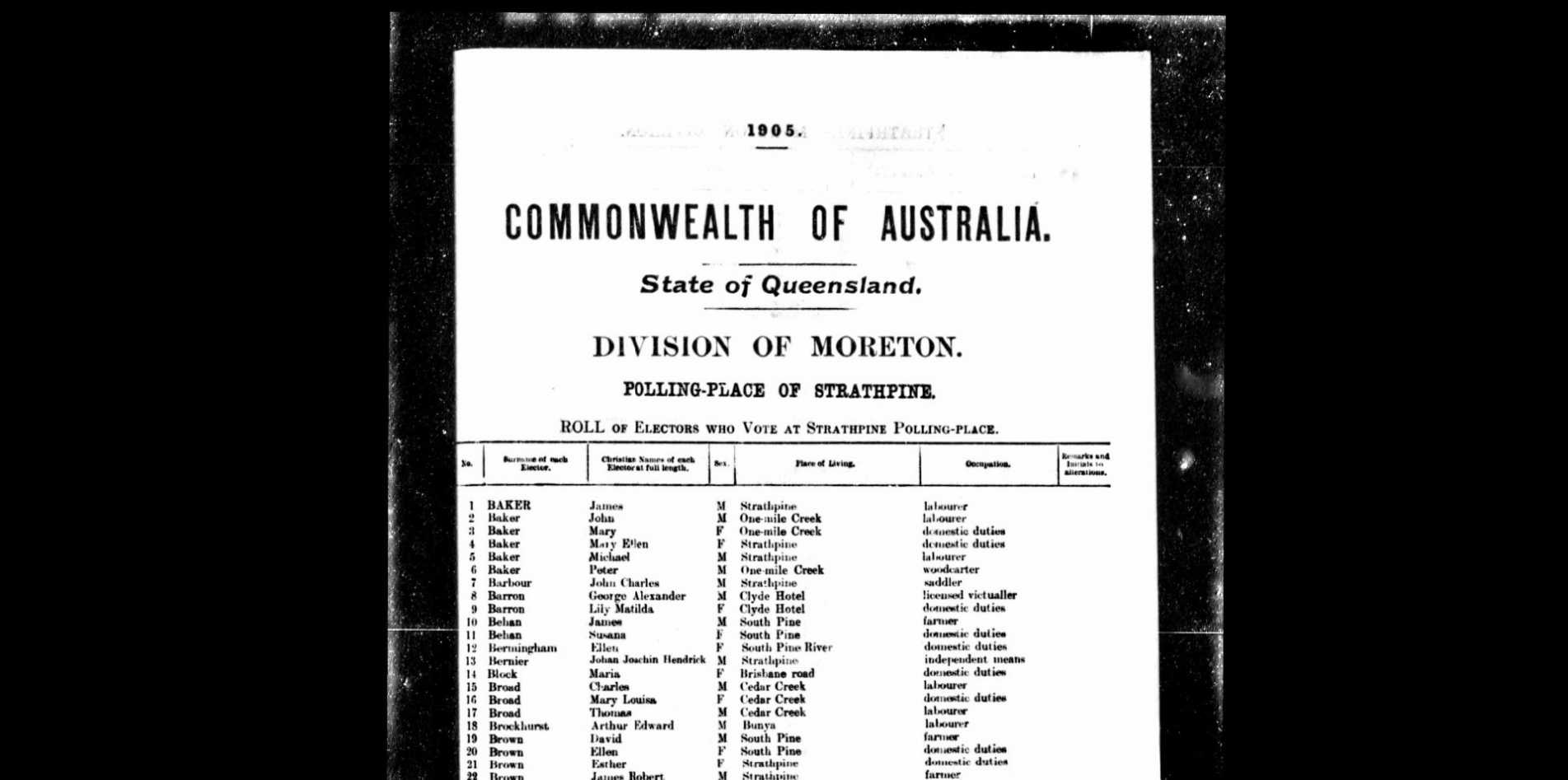
Ellen Bermingham was listed on a 1905 Moreton electoral roll as still living at the South Pine River property, domestic duties. She lived at South Pine for the majority of her life in Australia, but in her final years, moved to the inner north Brisbane suburb of Albion, with her daughter, a few years before her death.
My Great Grandmother Ellen Bermingham died on 24 December 1915 at Bate Street Albion, Brisbane, Queensland, when she was 77 years old & was buried at Lutwyche cemetery in section RC1, with her first husband John Dunn Snr.
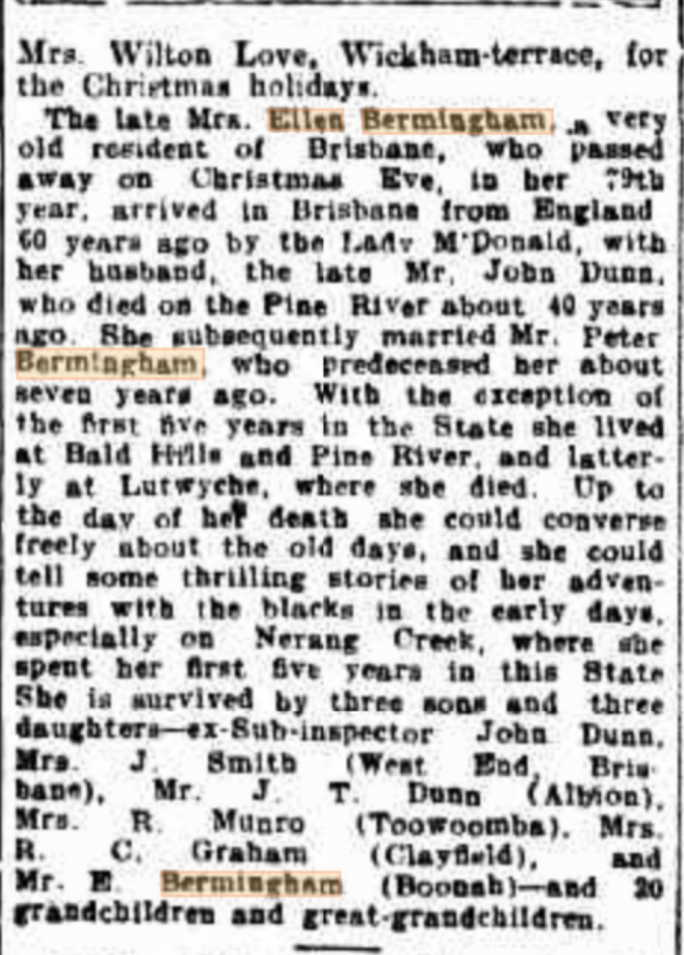
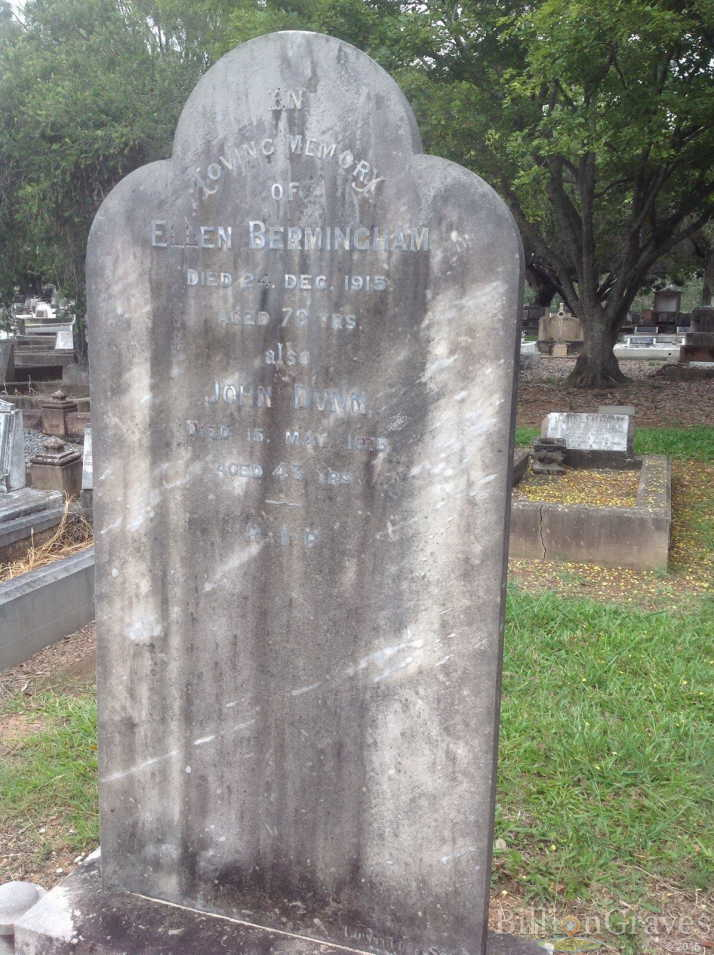
As a tribute to the original settlers and landowners of the district, Ellen Bermingham was among the many whose names were given to streets or landmarks in the modern-day Pine Rivers suburb of Eaton’s Hill.
Unfortunately, the authorities misspelled her name, designating it as Birmingham Street (with an “i”)—a common error made not only for Ellen and her husband Peter, but also for the author’s own family. Like many others, they too have experienced the frequent misspelling of family names.
There’s a touch of irony in this: over a century ago, such errors were often the result of limited education or poor record-keeping. Yet, even today—with far higher educational standards—these mistakes persist.
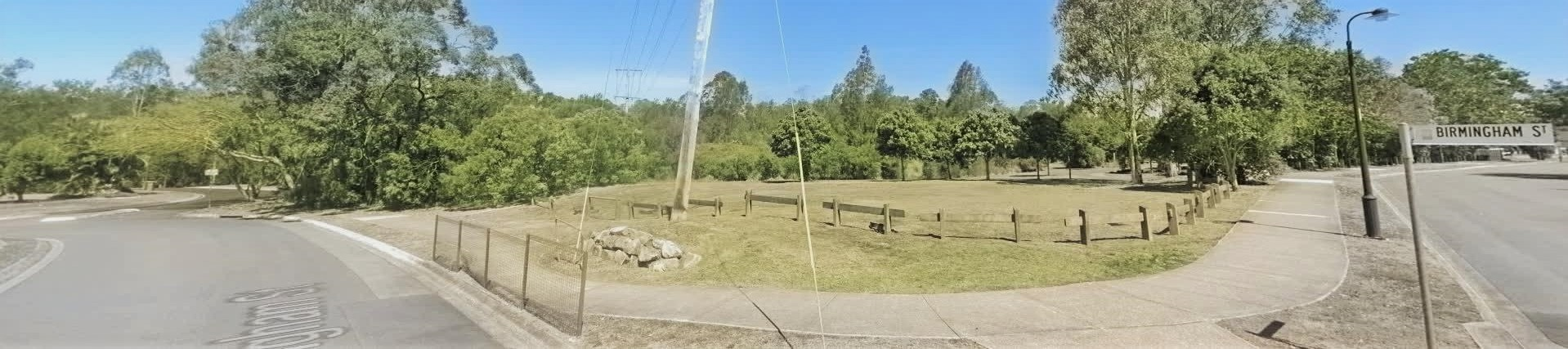
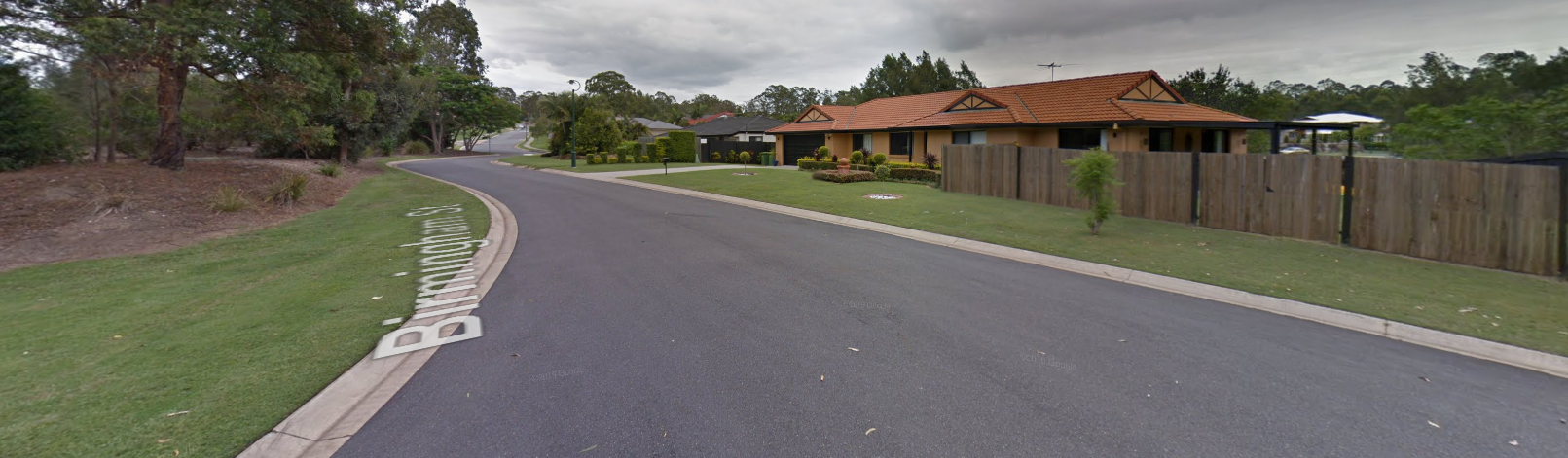
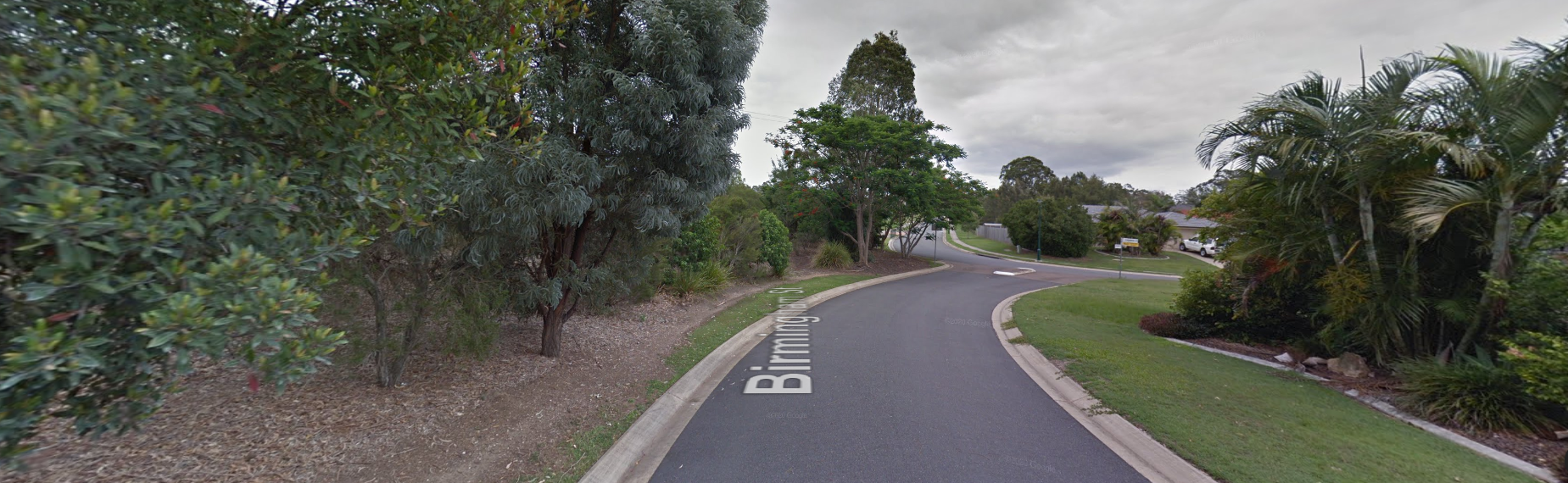
I’m sure Ellen Bermingham would be astonished by how much modern life along the South Pine River (Eaton’s Hill) has changed since her time there. Among the many generational differences since Ellen’s era, she would likely be fascinated by the population growth, the transformation of farmland into urban residential areas, the remarkable advances in agricultural practices, the increase in house sizes, the higher standards of education, and the expanded rights of women in modern Australia.
She would undoubtedly be amazed by today’s real estate prices in the area where she and her first husband, John Dunn, once leased land to begin crop farming and grazing in the late 1860s. In 1879, shortly after her marriage to Peter, Ellen Bermingham purchased the property outright for six pounds (approximately $12.00) per acre. By 2023, real estate prices on Bermingham Street, Eaton’s Hill, have risen to over one million dollars for a typical residential home on a quarter-acre block (about 1,000 square metres).

Like anyone who does research on their past ancestors, I think it would have been interesting to get to know some of them. For me, in particular, I would have loved to have met this amazing lady and heard her tell the stories of her incredible life, in person. She started life in a country that was deeply in a world of pain with wars, famines, ethnic and sectarian tensions, and epidemics and diseases carving a swathe through the population at the time. Ellen and her new husband immediately moved to the other side of the planet to make a new and better life for themselves. She suffered unbelievable tragedy in losing a husband and child simultaneously and nearly lost the farm at the same time. There were no obstacles in Ellen’s life that were going to stop her. She was a tough lady who took stock of the various problems that came her way and dealt with them. I think Ellen Bermingham (Dunn/Bowen), who was born in Nenagh, Tipperary, Ireland, 185 years ago, would have been very pleased to know that there are many of her feisty, strong-willed female descendants continuing her tradition and legacy in 2023, with one of them being my daughter Kathryn Bermingham (Ellen’s Great/Great Grandaughter), and the latest being my grandaughter, Samara Bermingham – Ellen Bermingham’s Great/Great/Great Grandaughter.
Geoff Bermingham


 porsche91722