
Reading time 28 minutes
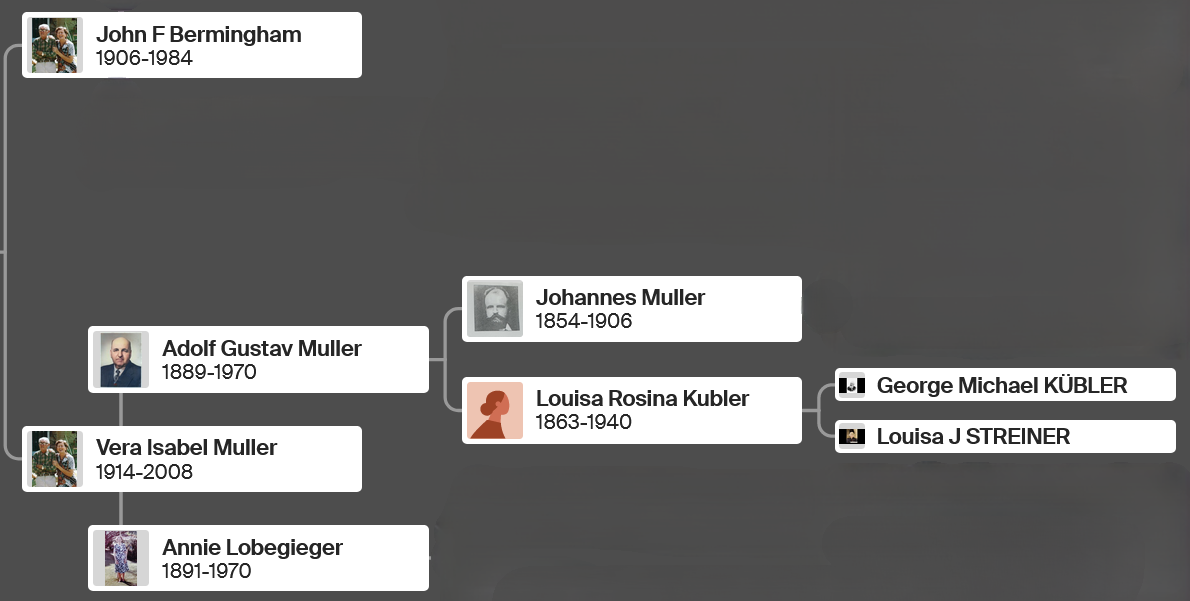
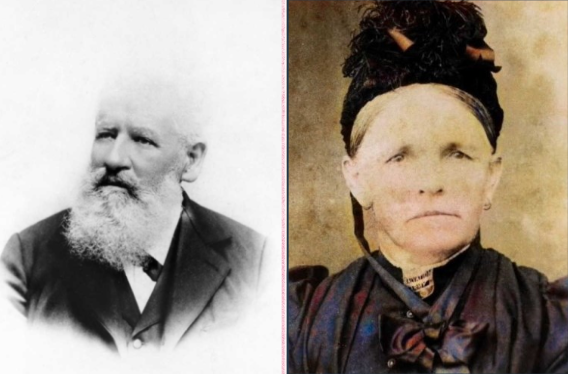
My Great Great Grandfather George Michael Kubler was born on 3 February 1840 Biberach, Baden-Württemberg, Germany. His father, George Michael Kubler (Snr), was 34 and his mother, Christina Barbara Schonau, was 34.
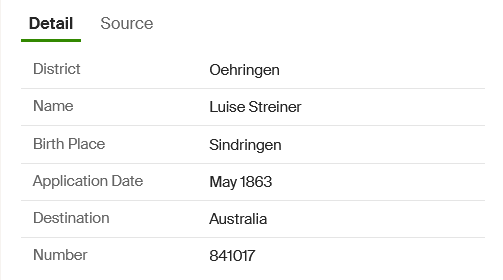
My Great Great Grandmother Louisa Johanna Streiner was born 9 Feb 1838 Sindringen Olnhausen, Heilbronn, Baden-Württemberg, Germany. Her father, Philipp Christian Streiner, was 32, and her mother, Eva Zentler, was 42.
It would be fair to say that Germany was in a total state of disarray at that point in their history. Perhaps, the more accurate statement or better still, a rhetorical question, would be – When was Germany/Prussia not in turmoil, in the last 1000 years? The country was in a never ending state of conflict! By the 1850’s, millions had left or had made plans to get out, at the earliest possible opportunity.
Many of the ultra conservative governments of the fragmented states that made up Germany, were in the process of introducing laws disallowing couples out of wedlock to be together. This, then led to legislation restricting marriage to those considered by the community authorities as morally and financially capable of rearing a family. Women who had become pregnant out of wedlock were ostracized & removed from their communities. Even for many of the far right, ultra conservative German population of the day, a lot of these policies were considered to be steps taken too far. These issues, together with the dismal state of the German economy, were forcing many young people to flee the country in droves. In the early stages, the main emmigration was from South Western Germany and consisted of small farmers, independent village shopkeepers and artisans. Germany’s young working class demographic, was being severely depleted.
In Baden Wurttemberg there was also no inheritance system in place. Land among large families couldn’t be passed down to descendants. This led to the ever decreasing sizes of farms that were being bought out by wealthy landowners. Germany was freefalling into an economy in recession.
By 1859, on the other side of the world in Australia, the Government of Queensland was crying out for laborers, tradesmen & farmers to come to the newly declared colony. It planned to achieve this goal by recruiting industrious settlers to populate, build & farm the new territory. Generous work contracts lured whole villages of peasants and tradesmen to Queensland. Each participant in the scheme was obliged to labor as a shepherd or boundary rider in the first instance. Wages were high and paved the way for land purchases, often to the annoyance of the ‘squattocracy’. There were great incentives to make the move – assisted passage, land grants, religious freedom & minimal government interference with family inheritances. Land orders lay at the heart of Queenslands immigration policies. Queensland was a highly competitive player in the immigrant market. Each full-paying adult was entitled to receive an £18 warrant for a land order. A further £12 land order was awarded after two years of residence in Queensland. The underlying principle in issuing the warrants was that they would be used to purchase as much land as possible & have experienced immigrant farmers growing crops and feeding the colony. Immigrants had an unfettered choice of land offered by the Queensland government anywhere in the colony.
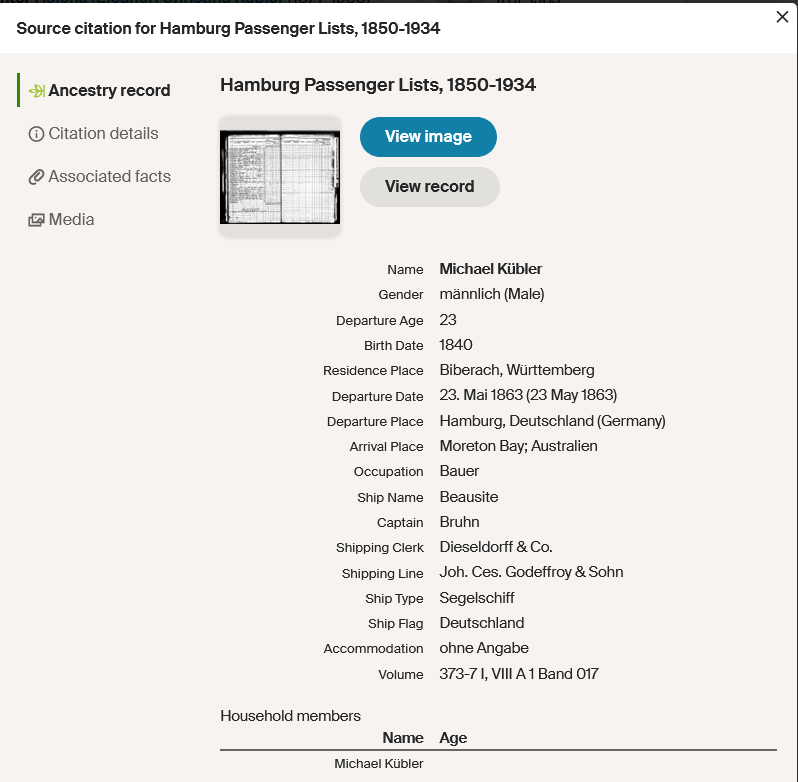
In April 1863, George Kubler & Louisa Streiner were in a relationship, but were struggling to find a reason to stay, in the dystopian state that Germany was in. Louisa was pregnant, so life would have been made even more difficult for her, if she were to stay in Germany. In consultation with their families, the couple made the decision to go to Australia. I am also sure, that financial assistance would have been given by the families in Germany. This would explain why, in the future years, after they were hopefully operating a successful farming venture, many Australian/German families sent money back home to the old country to help those, who had helped them, get started. It wouldn’t have been an easy call for the two young people, George 23 & Louisa 25, to make. I’m sure the promises by the Queensland government representives would have sounded to good to be true. They could have made the twenty seven thousand klm trip, & found out they’d been sold a load of bullshit promises. In any case, they decided on taking the gamble by making a life changing decision. They both made the necessary migration applications & booked their trips.

The journey was no luxury cruise by any standards. Personal hygiene wasn’t great & disease was a big problem on board the ships. Most people did not have room to change their clothing and often wore the same garments or clothing for the entire voyage. One can only imagine the smells of sea sickness, soiled nappies, dysentery, grubby clothes, and unwashed bodies in a crowded environment! The ships were all built from wood. Consequently, they all leaked badly. During storms, below decks were awash, where the passengers were locked down, with water continuously flooding through the compartmental areas. Keeping warm was a problem with no fires allowed. I won’t go into the toilet facilities on board the immigrant ships of the late 1800’s, but you can draw your own conclusions. Deaths at sea were common. Many didn’t make it to their destinations.
If that wasn’t bad enough, the sea conditions were treacherous. Some of the world’s most dangerous stretches of water, had to be navigated on the journey to Australia. In the North East Atlantic Ocean, adjacent to France & Spain, the Bay of Biscay is home to some of the Atlantic Ocean’s worst weather. In the South Atlantic, rounding the Cape of Good Hope at the southernmost tip of Africa, many ships were lost without trace, will all hands going down. So…. you can imagine what it would have been like for George & a very pregnant Louisa making the trip to Australia across the attrocious weather of the South Atlantic & Indian oceans.

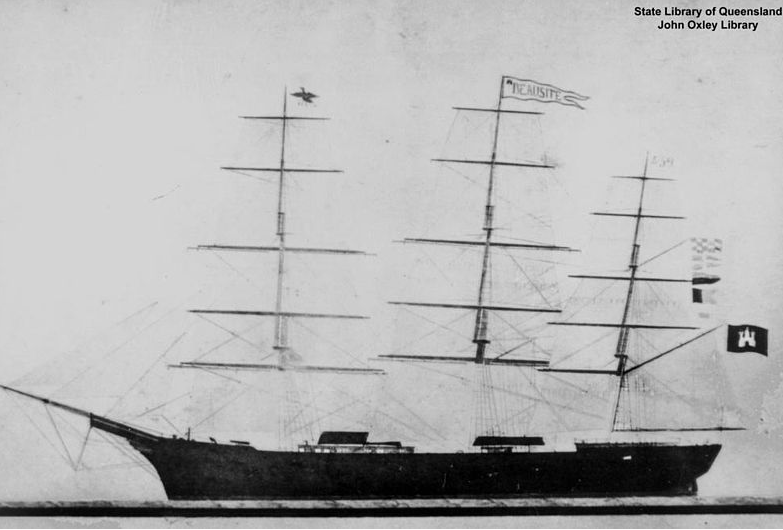
The Beausite was a 932 tonne passenger & cargo ship under the command of Captain C.I.S. Bruhn, owned & operated by the Cesar J Goddefroy Line out of Hamburg Germany. It was mainly used to carry immigrants. After leaving Hamburg on May 26, with 508 passengers on board, the Beausite arrived in Moreton Bay, 102 days later, on September 5 1863.
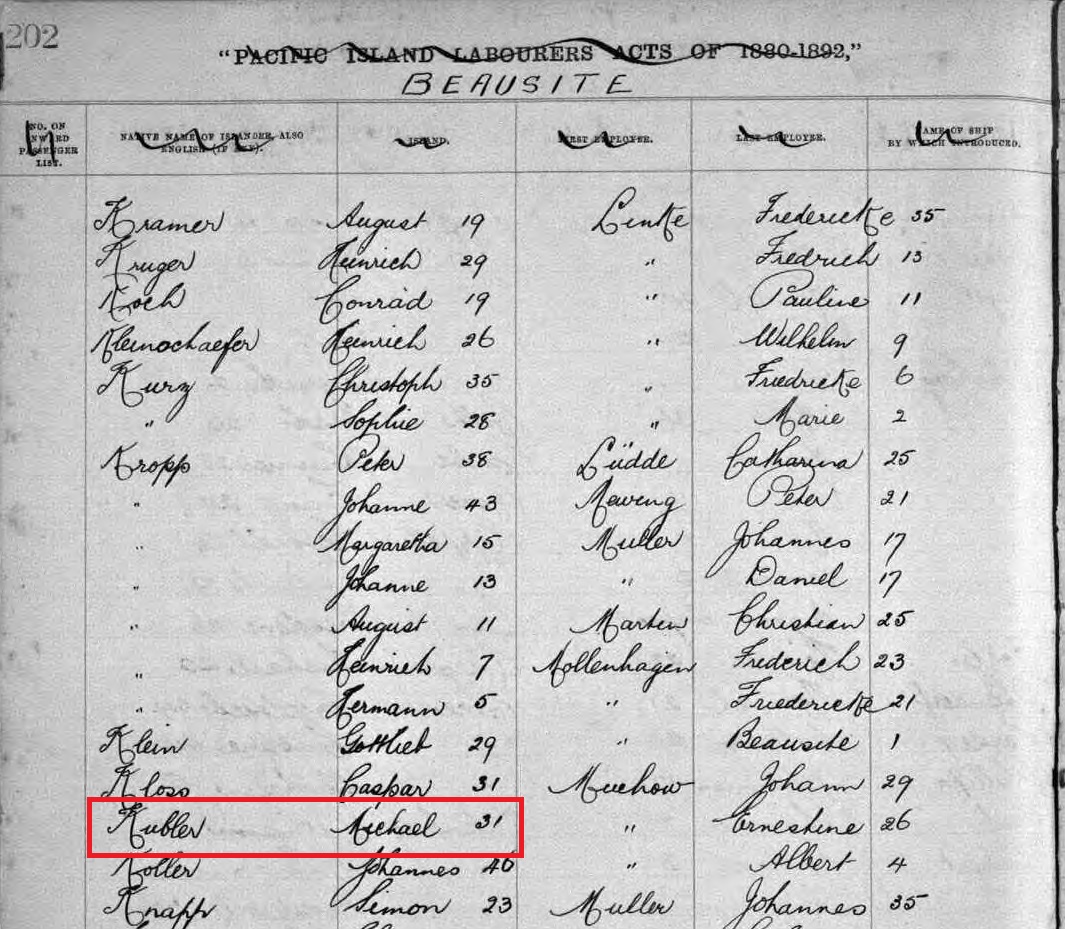
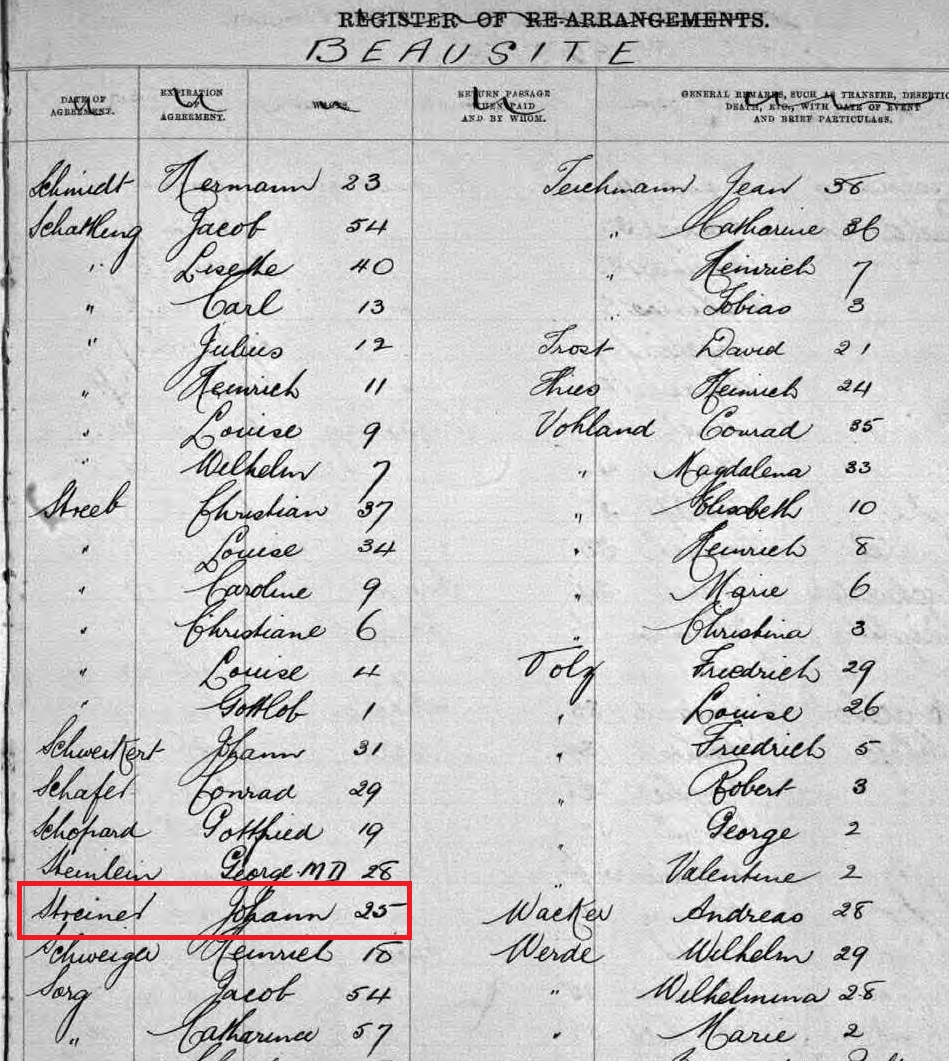
There were ten deaths onboard due to illness. Five were caused by “various inflammatory affections of the lungs” and the other five were caused by “other complaints, but chiefly from diarrhoea.” On board there were also nine births, six boys and three girls.
The Beausite reached the roadstead at Moreton Bay on September 5 1863 but had to wait to complete a health inspection. Two days later on Monday, September 7, the Beausite was visited by Dr. Hobbs the health officer. Dr. Hobbs found the Beausite’s passengers to be of satisfactory health and gave them the all-clear to disembark.
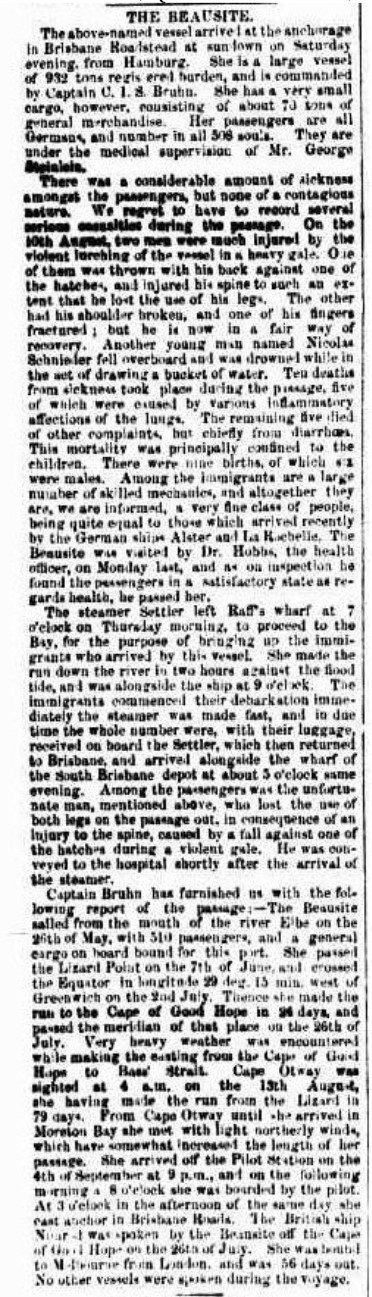

Three days later, the steamer “Settler” left Raff’s wharf (located at present-day Eagle Street, Brisbane CBD) to retrieve passengers on the Beausite out in Moreton Bay. It took the Settler two hours to travel from the wharf to the ship. All 508 passengers disembarked the ship and arrived in Brisbane on the steamer at 5pm.
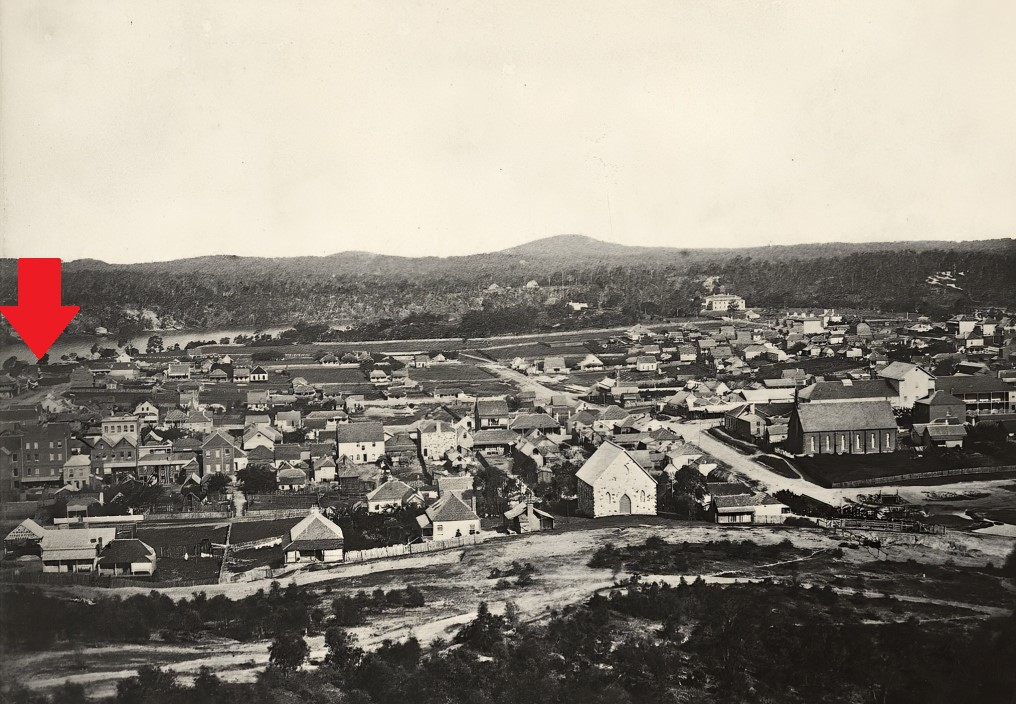
After stepping ashore on to Australian soil, on Thursday September 10 1863, George Kubler & Louisa Streiner were taken straight to accomadation at Nundah, on Brisbane’s northside. Missionaries from the Lutheran Church had set up the German Station at Nundah in 1844 with the primary aim of converting the local indigenous people to christianity, but also to assist German immigrants in finding accomodation & employment after their arrival in Brisbane. The latter was more successful than the former.

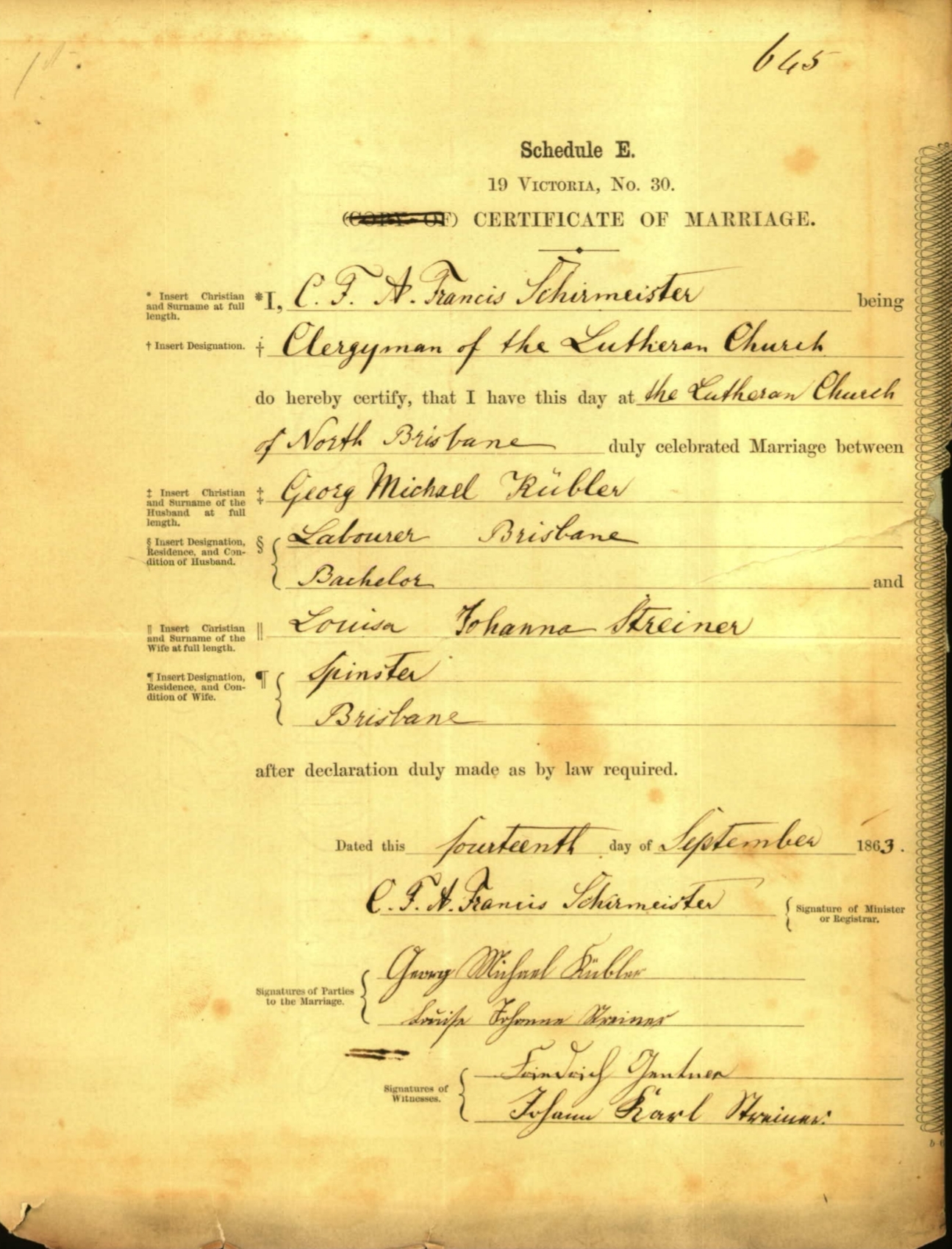
George Kubler & Louisa Streiner became husband & wife when they were married four days later, at Nundah in Brisbane, on 14 September 1863. Pastor C. F. A. Schirmeister, who is acknowledged as the father of the Lutheran Church in Queensland, performed the ceremony at Zion’s Hill (German Station) at the North Brisbane Lutheran Church.

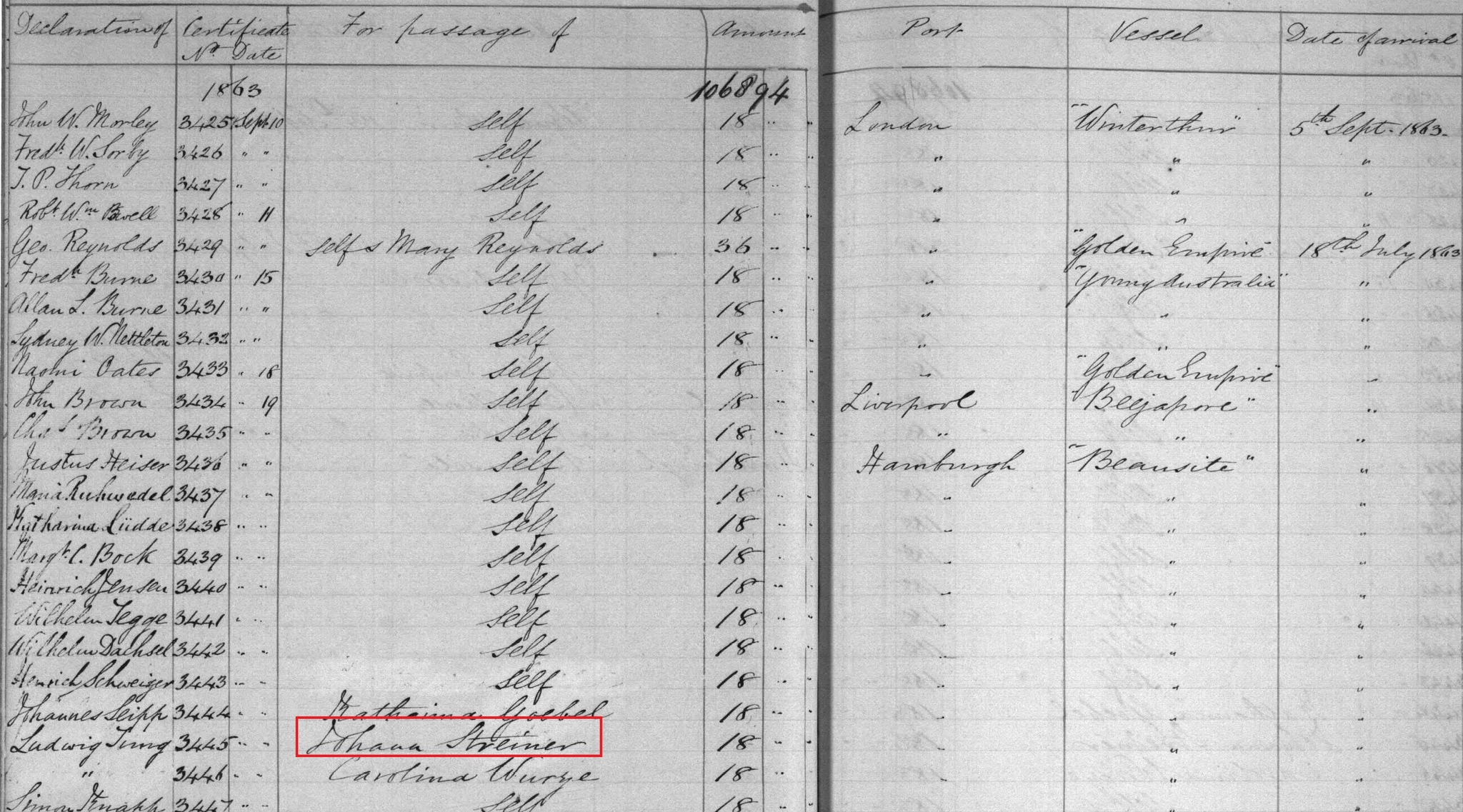
As George & Louisa paid for their own passage to Australia they were eligible for Queensland Land Grants of £18 land grant each, which they claimed in 1863.
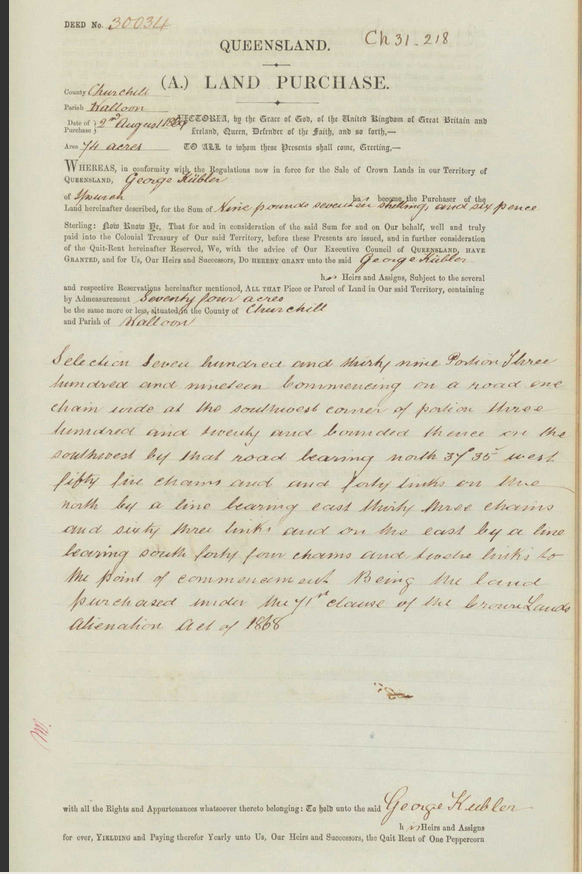
In Aug 1869 George applied for a 74 acre selection at Walloon on what is now known as Caledonian Road. His selection was portion 319 in the parish of Walloon (not far from the present day RAAF base at Amberley). He was issued with the deed of grant for this land in 1875.
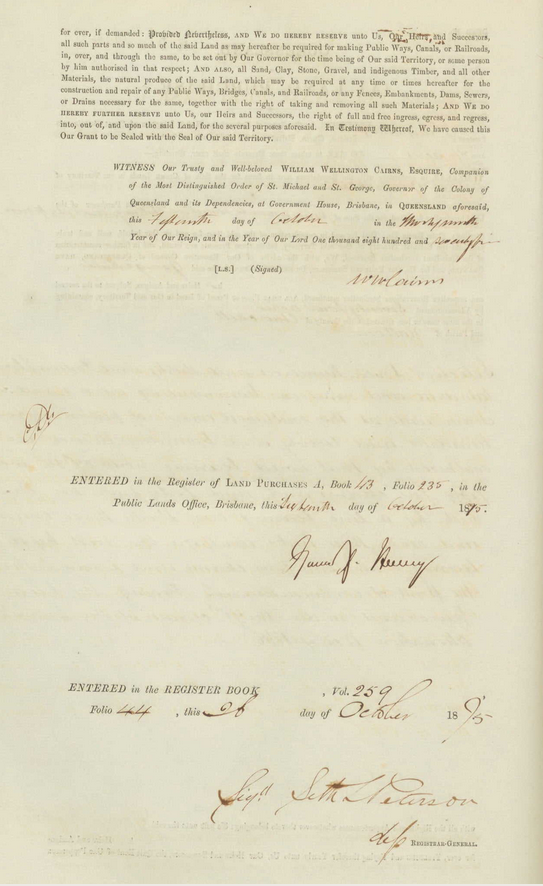
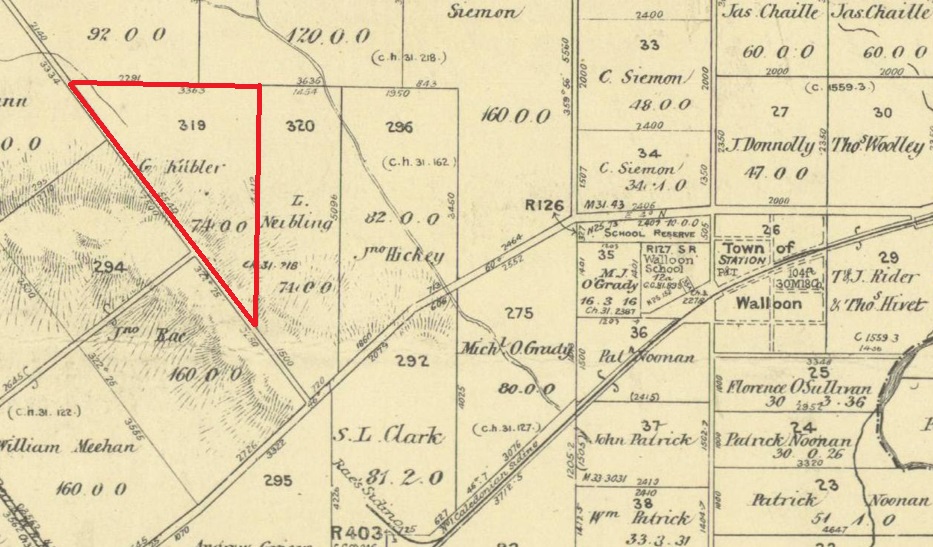
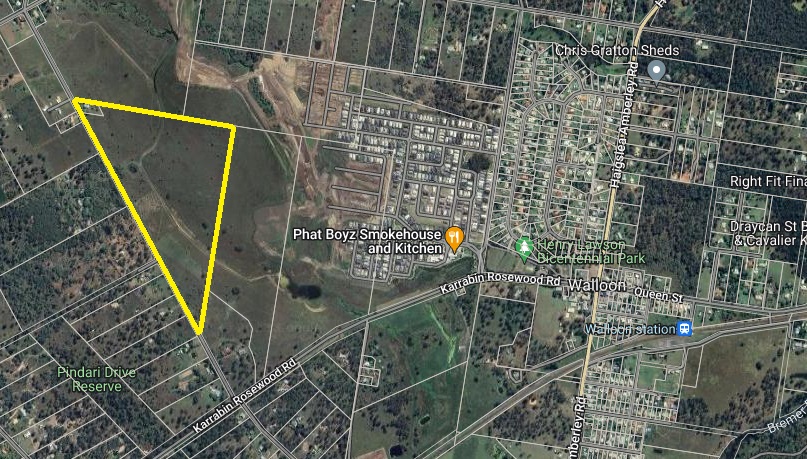
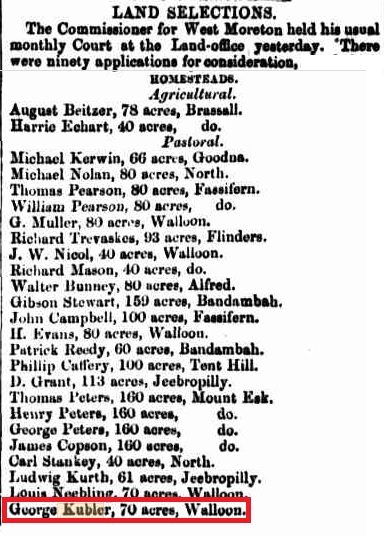
In 1874 George had been issued with the livestock brand of G8K.
Their first baby, Louisa Rosina Kubler (my Great Grandmother) was born on the 11th December 1863 at Walloon Ipswich.
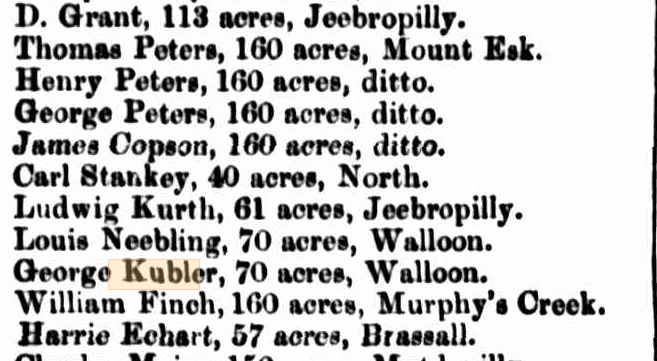
In August 1869, George’s land grant for Walloon was finalised & approved. The Germans were certainly industrious. They didn’t mess around. In five years, George had made his farm into a profitable operation, starting from scratch. In the 1860’s, the Walloon /Rosewood area, surprisingly was growing successful quantities of sugar cane & cotton. Cane would have done well, as the whole of the decade were heavy rainfall years. The American Civil War had stopped the supply of cotton to the British spinning mills. Queensland grown cotton was in demand.
By the early 1870’s, there were still plenty of German, Irish, English & Scottish migrants regularly arriving in Queensland & many of them were heading west of Brisbane to the newly opened Ipswich Reserve to take up their land grants.
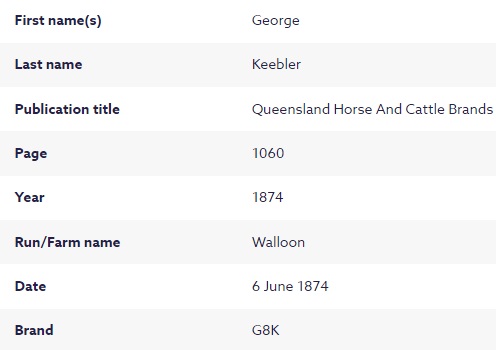
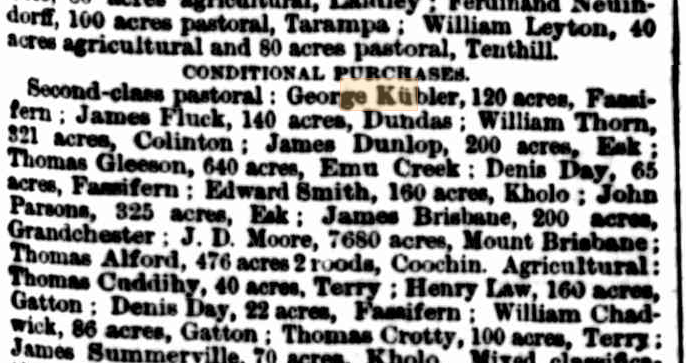
Although the soil quality at Walloon was passable for growing cane & cotton, it wasn’t great for growing many food crops. They’d had good rain in the 1860’s, but the weather patterns were changing. Maybe an earlier version of what we now know as El Nino. Rainfall had significantly dropped off by the early 1870’s. By around 1874, George needed more land & better access to water for irrigation.

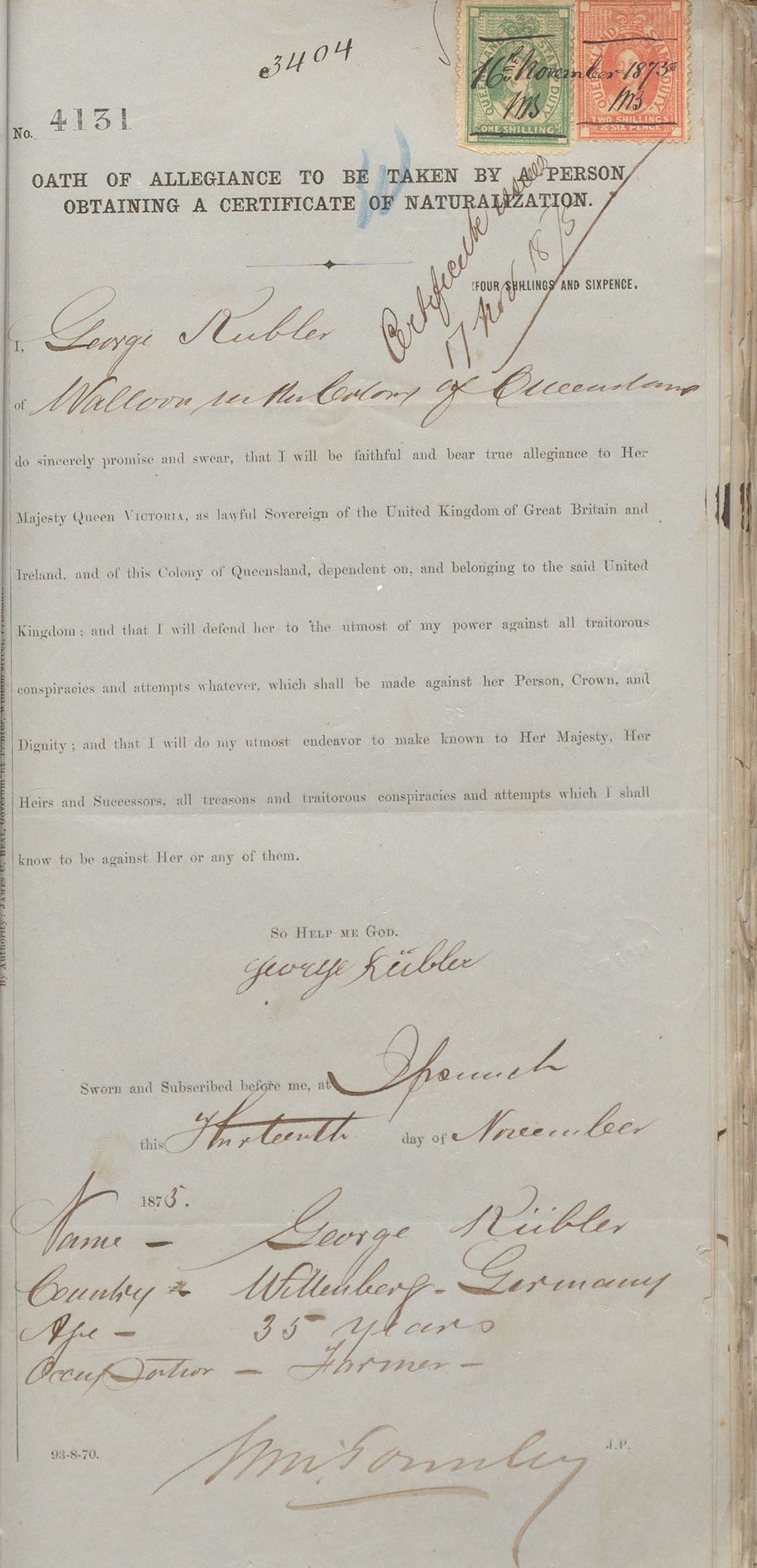
On the 13th Nov 1875 George Michael Kubler became a naturalized citizen of Australia swearing his allegiance at Ipswich , his occupation is listed as a farmer and his age was 35 years old.
The Fassifern Valley was the next area to be opened up for selection. The Fassifern Station run had been part of the enormous Wienholt Brothers cattle grazing empire. Much of it was resumed and publicly offered up for crop farming selection on 19 April 1877. George Kubler actually worked for the Wienholt’s at Fassifern Station for a time, as Chief Horseman (stockman). I don’t know whether George had “inside” information, but as can be seen from the above Brisbane Courier newspaper ad for 12 June 1876, he was able to purchase 120 acres of prime farming real estate much earlier than others may have been able to do so. George & Louisa Kubler sold the Walloon property after farming there for just over a decade & in 1878, they moved further southwest (approx 50 klms), where they had selected their land not far from the base of the Great Dividing Range & close to a good reliable water source in Reynolds Creek, that flowed off the ranges. The rich & fertile soil of the Fassifern would deliver much better crop yields & superior grazing land than Walloon.
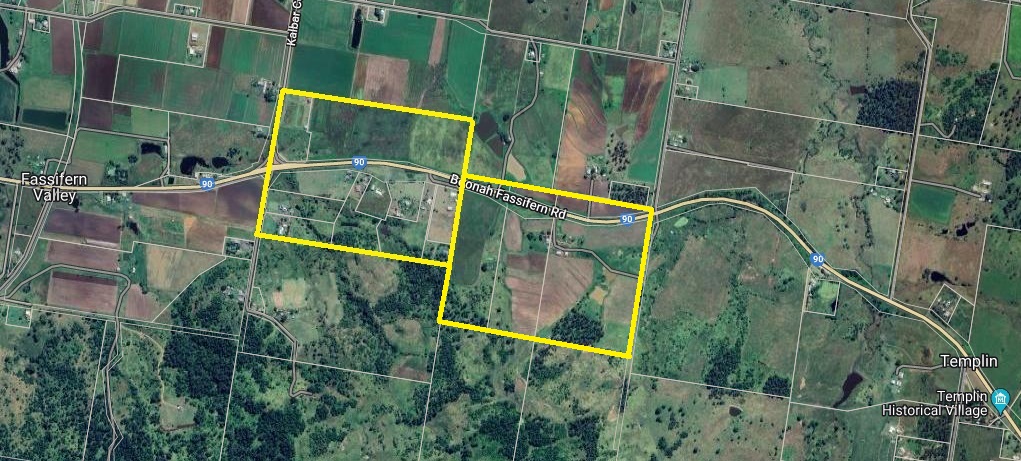
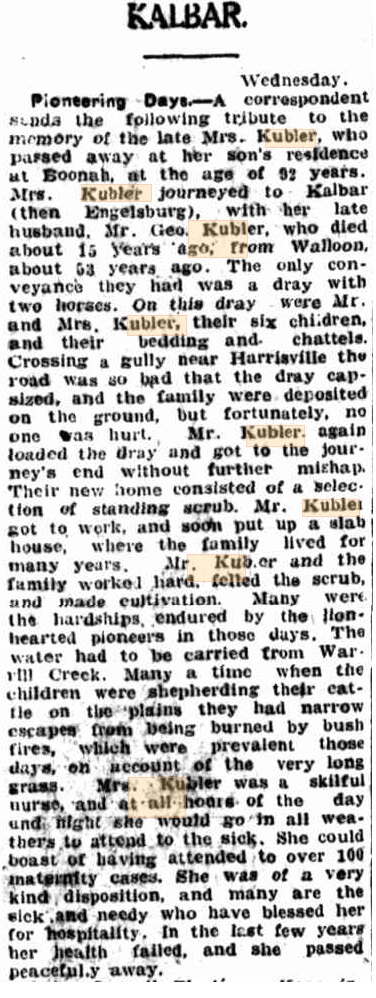
George selected 119 acres of land in the parish of Fassifern in 1878 being portion 204a in the Fassifern Valley on Boonah Fassifern Road , The family departed Walloon heading for their new land in the Fassifern Valley on the only conveyance they had which was a dray with two horses. On this dray were George & Louisa Kubler , their seven children and their bedding and chattels.
Crossing a gully near Harrisville the road was so bad that the dray capsized and the family were deposited on the ground , but fortunately no one was hurt.
George again loaded the dray and got to the journeys end without any further mishap.
Their new home consisted of a selection of standing scrub. George Kubler got to work and soon put up a slab house.
A Kubler family record, referring to one of the sons – Charles John Kubler, states – “Born at Walloon, near Ipswich (in 1870), he came to the Fassifern district at the age of seven (1877) with his parents, the late Mr and Mrs George Kubler. The journey took three days to complete as the family had to walk beside their only dray which was used to carry their utensils. He lived with his parents at Fassifern for some years”.

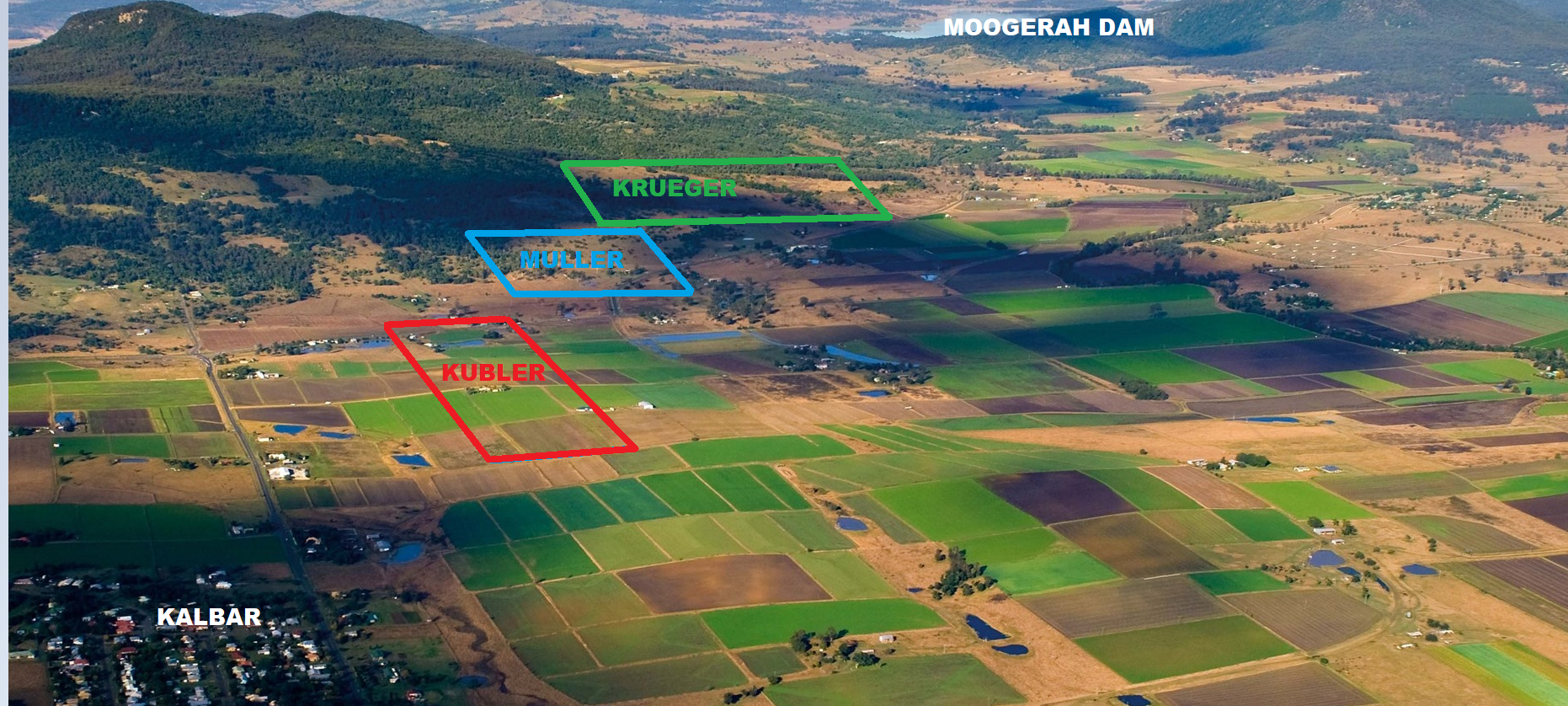
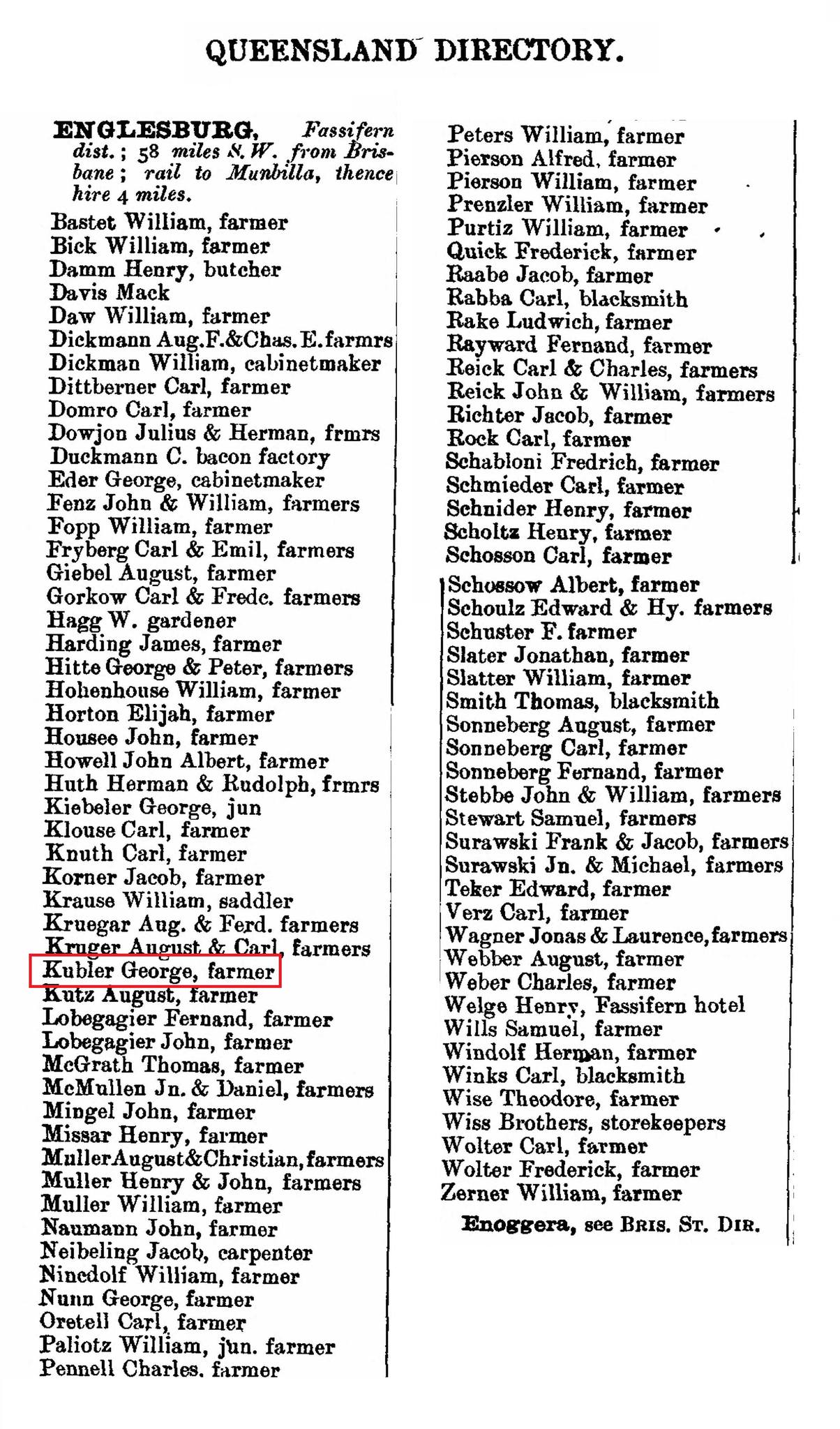
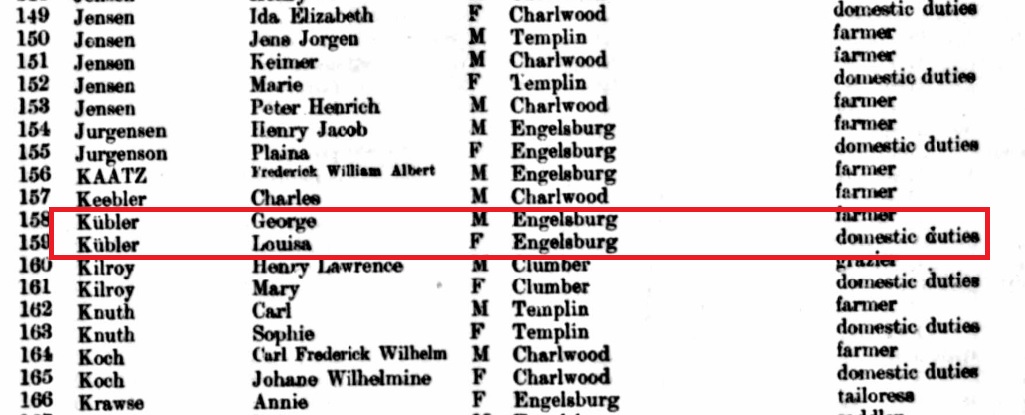
The Kubler’s land selection was near Engelsburg (Kalbar). Take a moment to think about how you’d go shifting a family, George, Louisa & seven kids (aged 2-14) by horse & cart up to the Valley through an area of thick scrub, with no roads, crossing creeks & only a hardly visable rough track. On arrival, they would have had to clear the thick heavy bushland, & then erect a house. Water sources needed to be found for stock & human consumption. Fences had to be built & crops planted. All the pioneer farmers had to be self sufficient & hit the ground running, immediately from day one on their land.

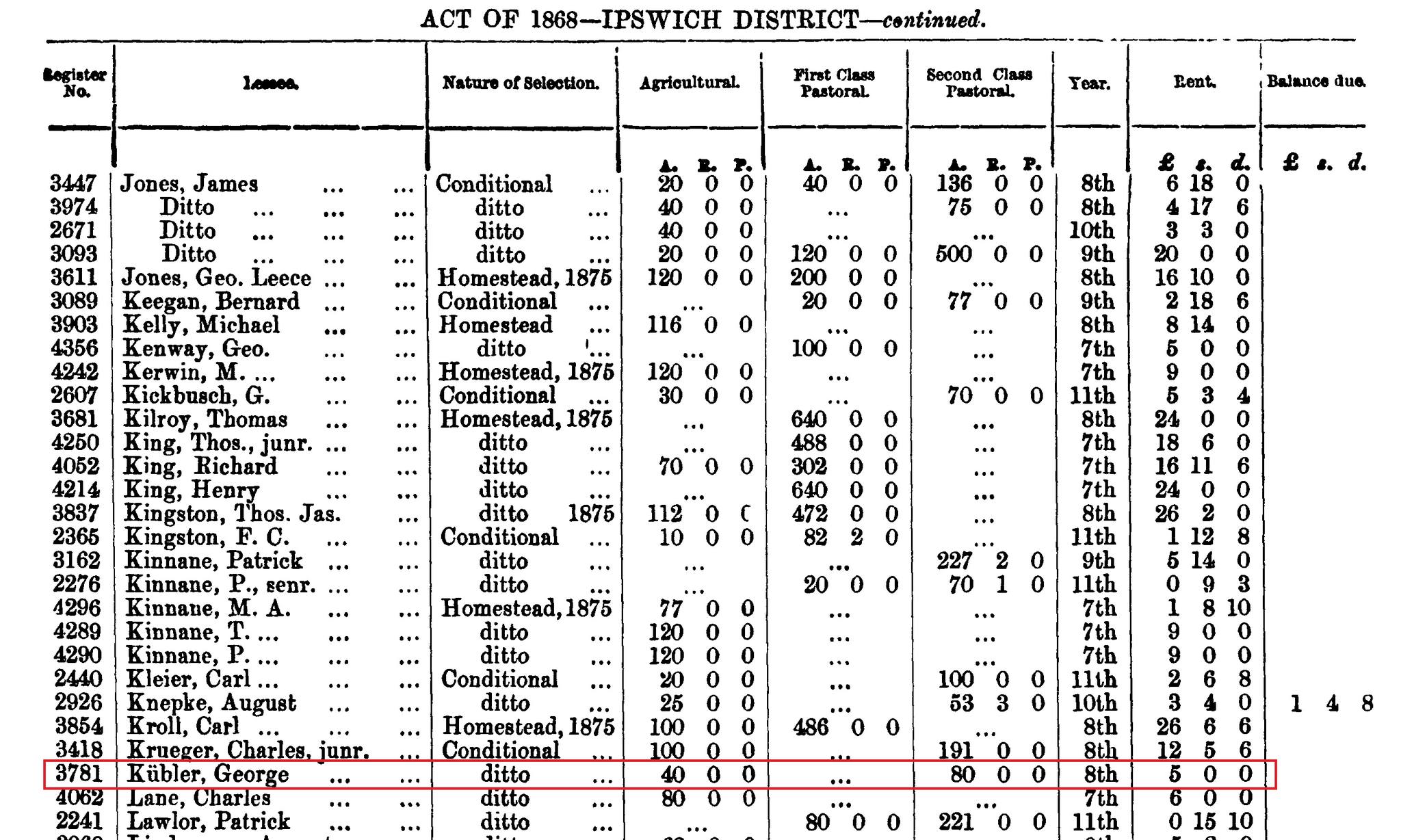
George was paying an annual rent of £5 on his land and was issued with the deed of grant in 1886.

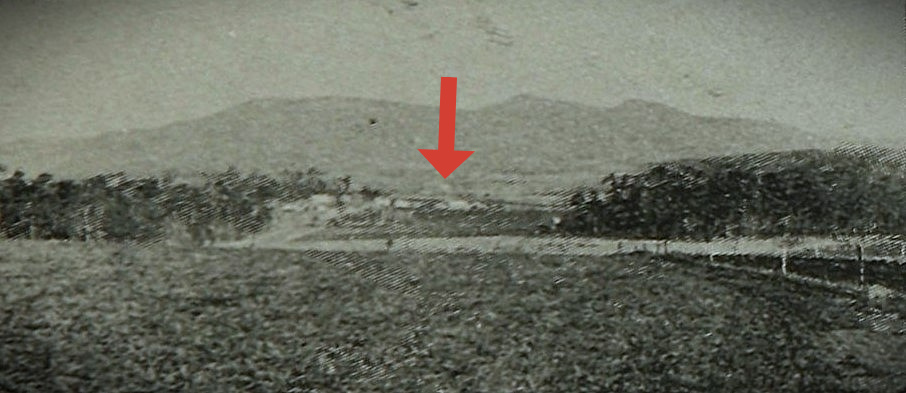
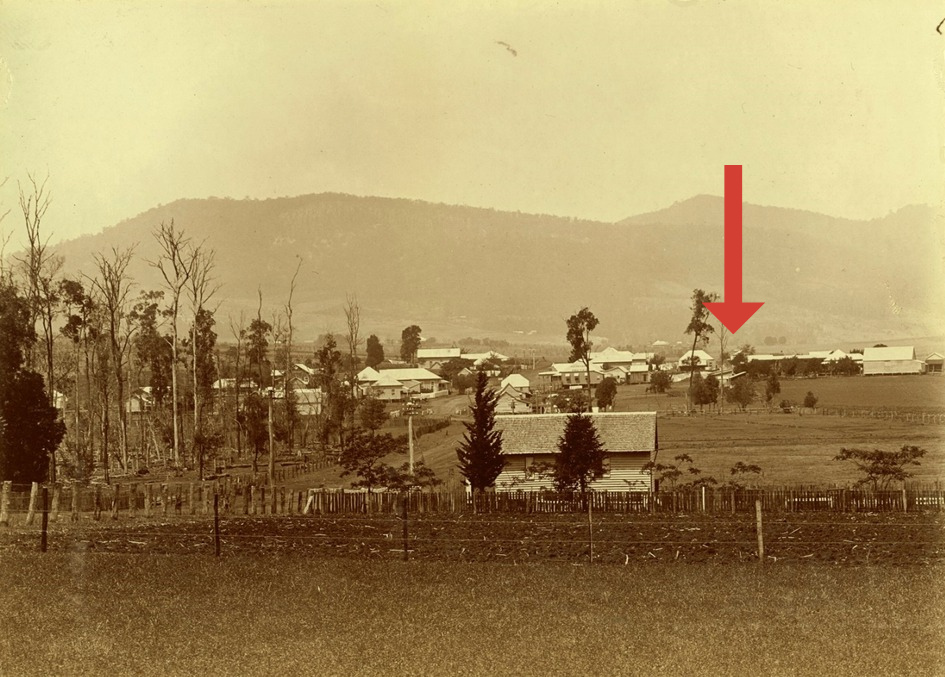
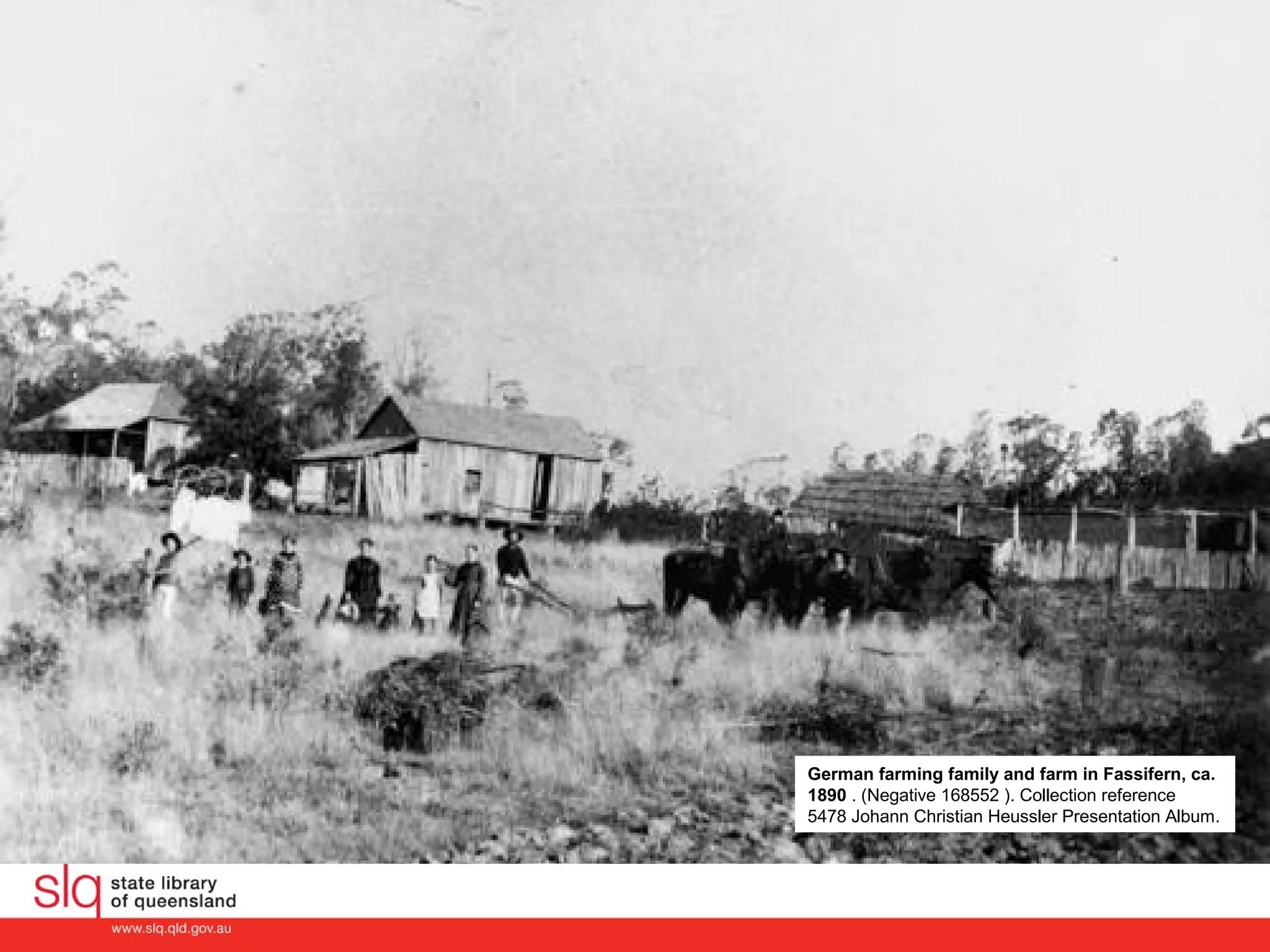
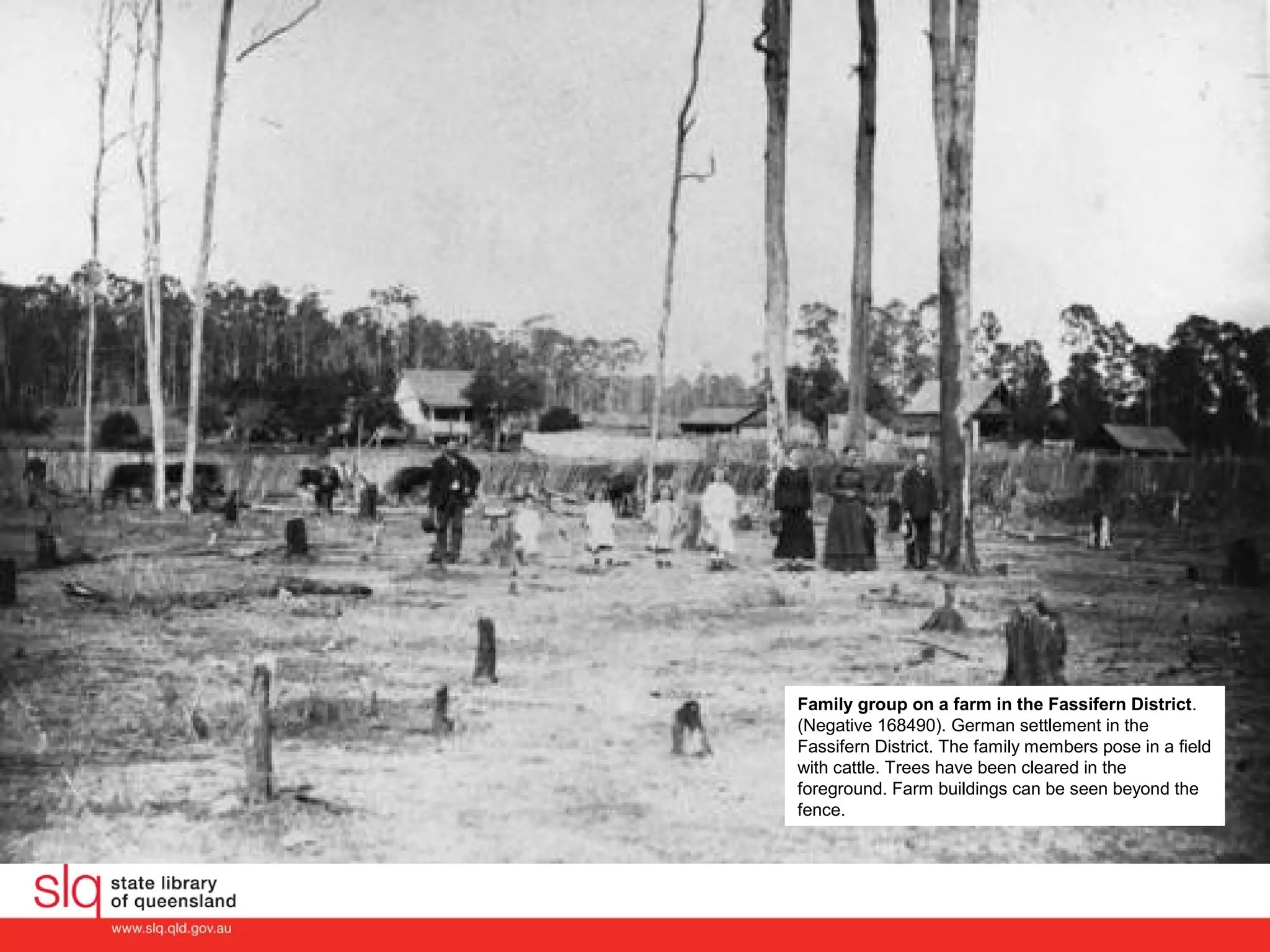
In those early images, you can see how dense the “Fassifern Scrub” was during the settlers’ early days. The trees stood 20 to 30 meters high and were almost impenetrable. Land clearing, with only hand tools available, would have been an arduous, backbreaking task. To clear the land for farming, settlers resorted to ringbarking many of the trees.
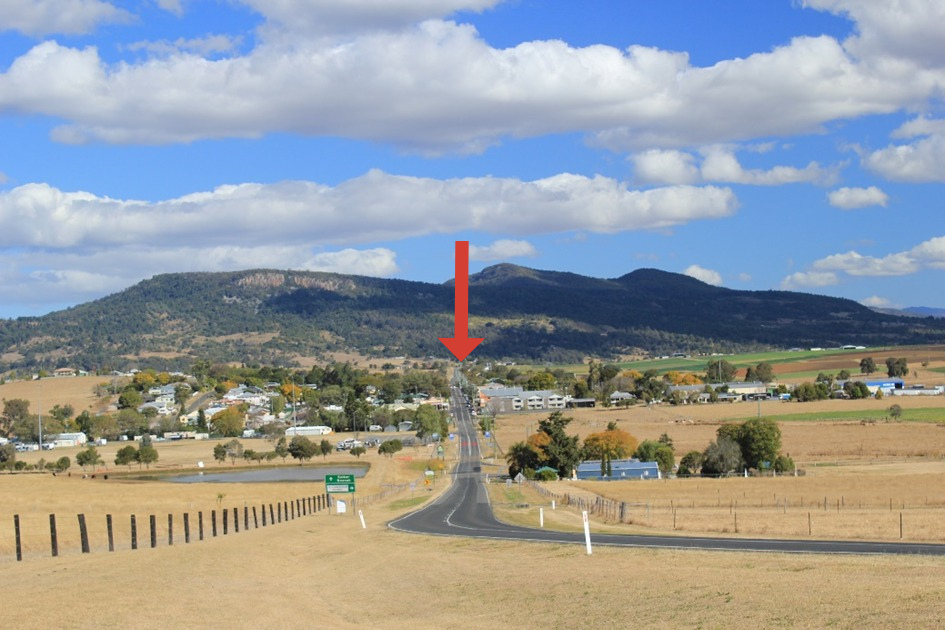
The difference between the top two photos, taken ten years apart, highlights the transformation—showing how much dense scrub had to be cleared. A modern-day photo below, taken recently from roughly the same spot, offers a stark contrast, looking toward the range in the background.
Our other ancestral families—Johannes and Louisa Muller (daughter of George and Louisa Kubler) and Carl and Johanna Krueger—were nearby neighbors of the Kublers, with their farms located in the same vicinity.
By 1896 George had purchased the neighbouring 120 acres of land being portion 202a giving him a total of 239 acres.
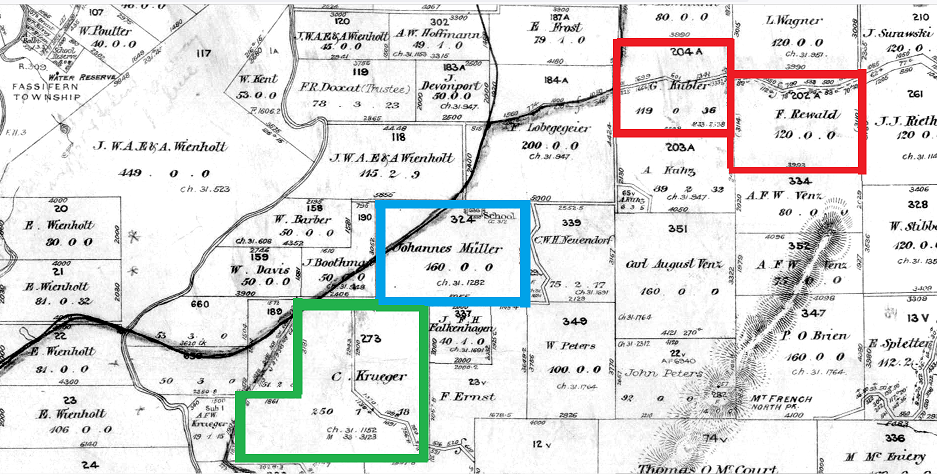
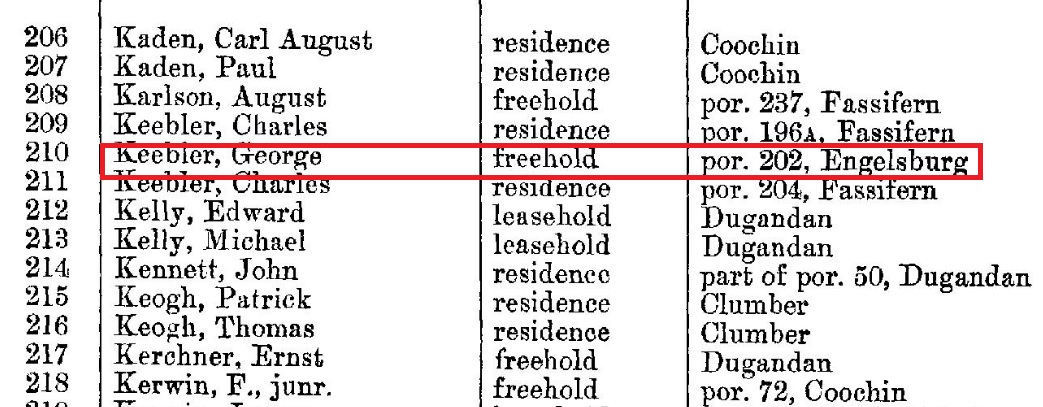
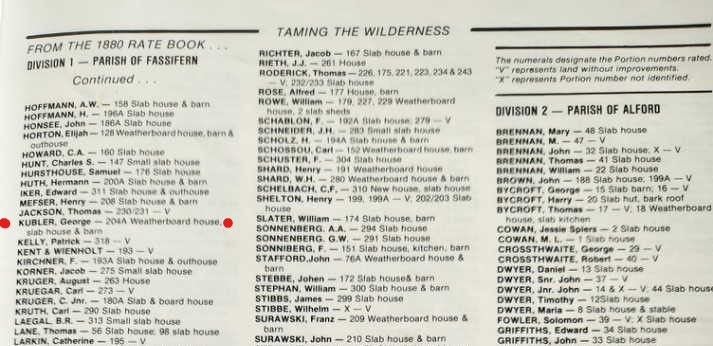
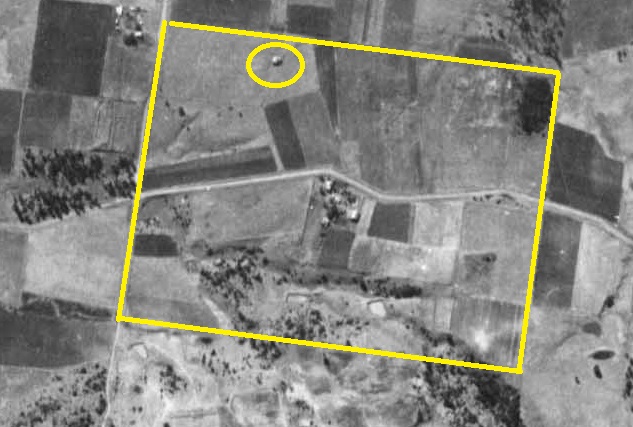
The earliest actual official record of them living at Fassifern Valley is an 1880 rates book, showing a dwelling on 119 acres.
All of the early pioneer families were prodigious breeders. Their first child, Louisa Rosina (my Great Grandmother) was born in 1863 at Ipswich.
Siblings – Phillip George-1865, Catherine Elizabeth -1866, Caroline Mary-1868, Charles John-1870, Helena Christina *- 1871, Helena Eleanor Christina -1872, Christina Sophie* – 1873, & Minnie Margaret -1875 were born while they were residing at Walloon Ipswich.
Siblings – Emma Ernstine* – 1877, Johan Ludwig-1878, Bertha Johanna-1880, Michael-1882 & Alfred Edwin-1886 were born at Fassifern.
*Sadly, three of their babies (all girls) died under one year old. Access to doctors & health care for farmers & their families was non existent. Boonah didn’t get a hospital until 1900. Fassifern to Ipswich was a full day trip in a horse & sulky. There was no proper ambulance service operating in Queensland until 1892 & then it was done on foot with stretchers. Most births took place in the home at the farm. Many families lost babies at birth or soon after.

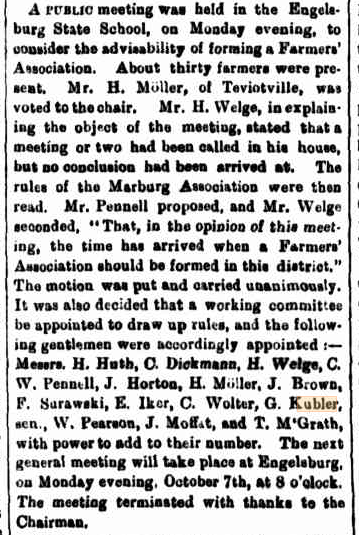
It appears that George Kubler grew maize, lucerne (hay) and dabbled with a little bit of sugar cane on the farm at the time. There were attempts to grow cane, cotton & tobacco in the Valley in the early days, but they were never really successful. Some crops needed more rain & irrigation than what the prevailing weather conditions of the time were delivering. This period was prior to any of the large dams being built. Moogerah Dam was still about another 80 years away. Water from Reynolds Creek irrigated the properties in the Fassifern Valley near Kalbar. Most of the farmers were relatively new to the area & were still learning the local elements, but they weren’t afraid to try many different types of crops. Most early farmers grew a mix – maize, potatoes, pumpkins, carrots, lucerne & also ran beef & dairy cattle. Most of the produce was sent into Boonah & Ipswich. Refrigerated transport wasn’t yet available. As with most of the Germans, the Kublers would have also had a vegetable garden & the customary pig sty & chook pen. The following is a newspaper article from the “Brisbane Courier” dated April 16, 1883.
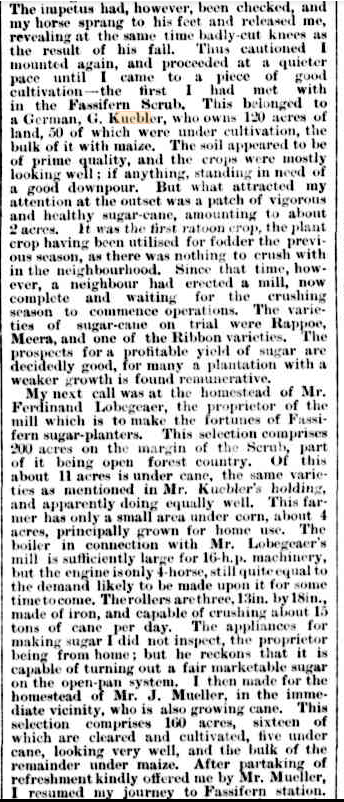
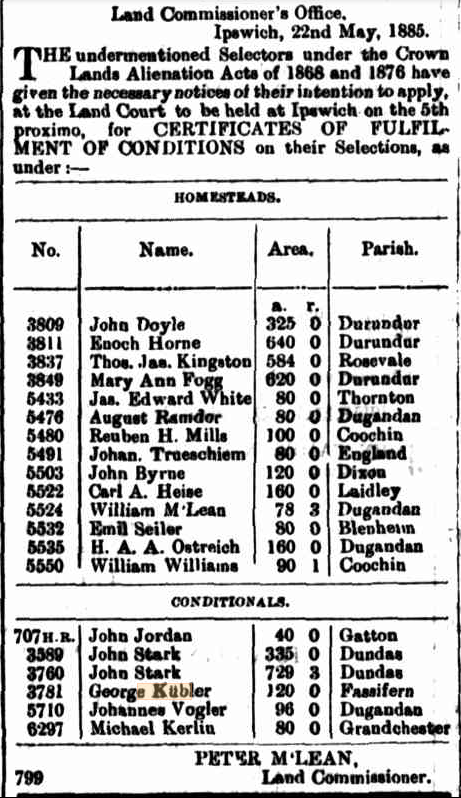
The first settlers in the Fassifern district tended to select their land by way of their ancestral farming backgrounds. The English settled on creek flats around where the towns were situated. The Scots and Irish were attracted to the undulating timbered country. The Germans chose the rich soil of the Fassifern Scrub, heavily wooded and to the north of the other groups. In the 1870’s, the new arrivals were greeted by severe drought. Not an auspicious beginning. Surviving records show that not one of those first settlers abandoned his selection despite what must have appeared to be almost insurmountable problems. Their tenacity as a group has been attributed to Irish perversity, Scottish unwillingness to part with what they regarded as theirs, English reluctance to admit defeat and sheer dogged persistence on the part of the Germans. The over-riding factor was that, for the first time, the majority of the pioneers were working their own land, as opposed to life as a tenant farmer or an agricultural labourer in their country of origin. The goal of freehold tenure was not to be surrendered lightly.
The Kubler family home was located on the top of the hill on the right hand side of the Boonah – Kalbar turnoff at Fassifern Valley. In 1880 they were known to have a weatherboard house, slab house and barn. They returned to Germany two or three times to visit relatives”.

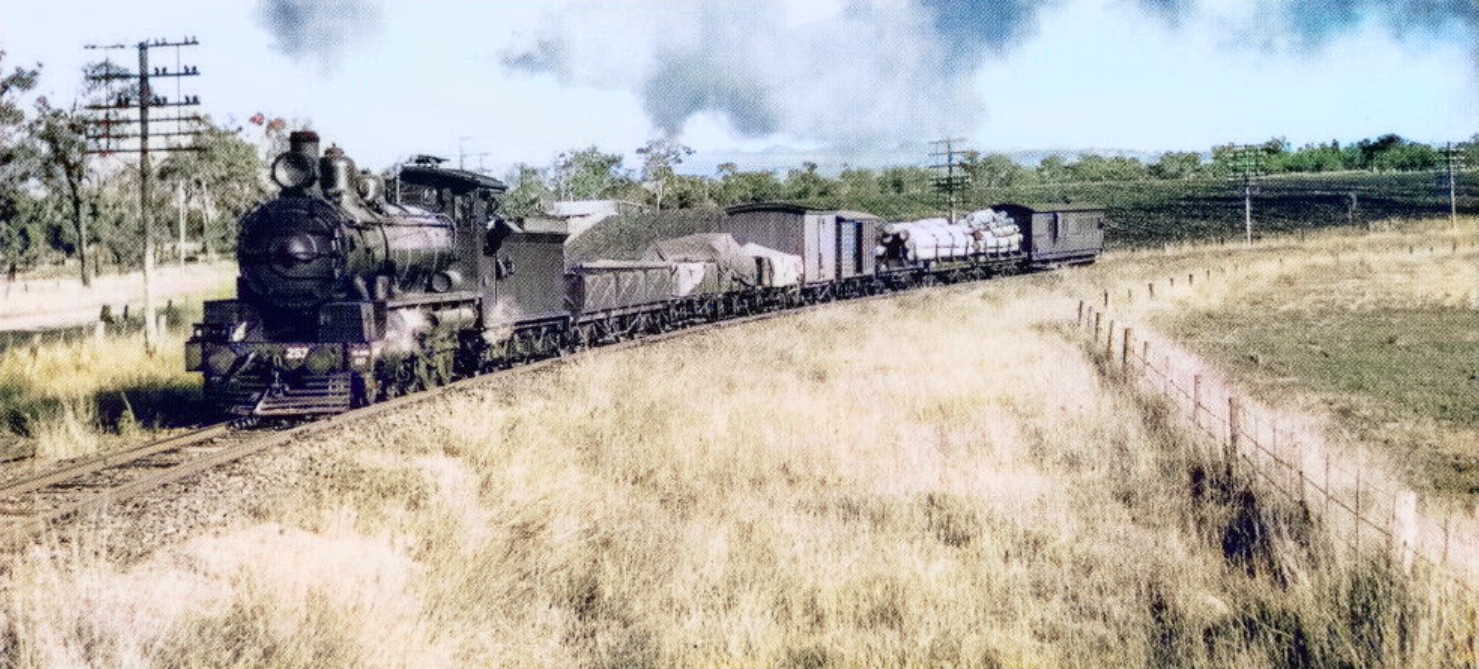
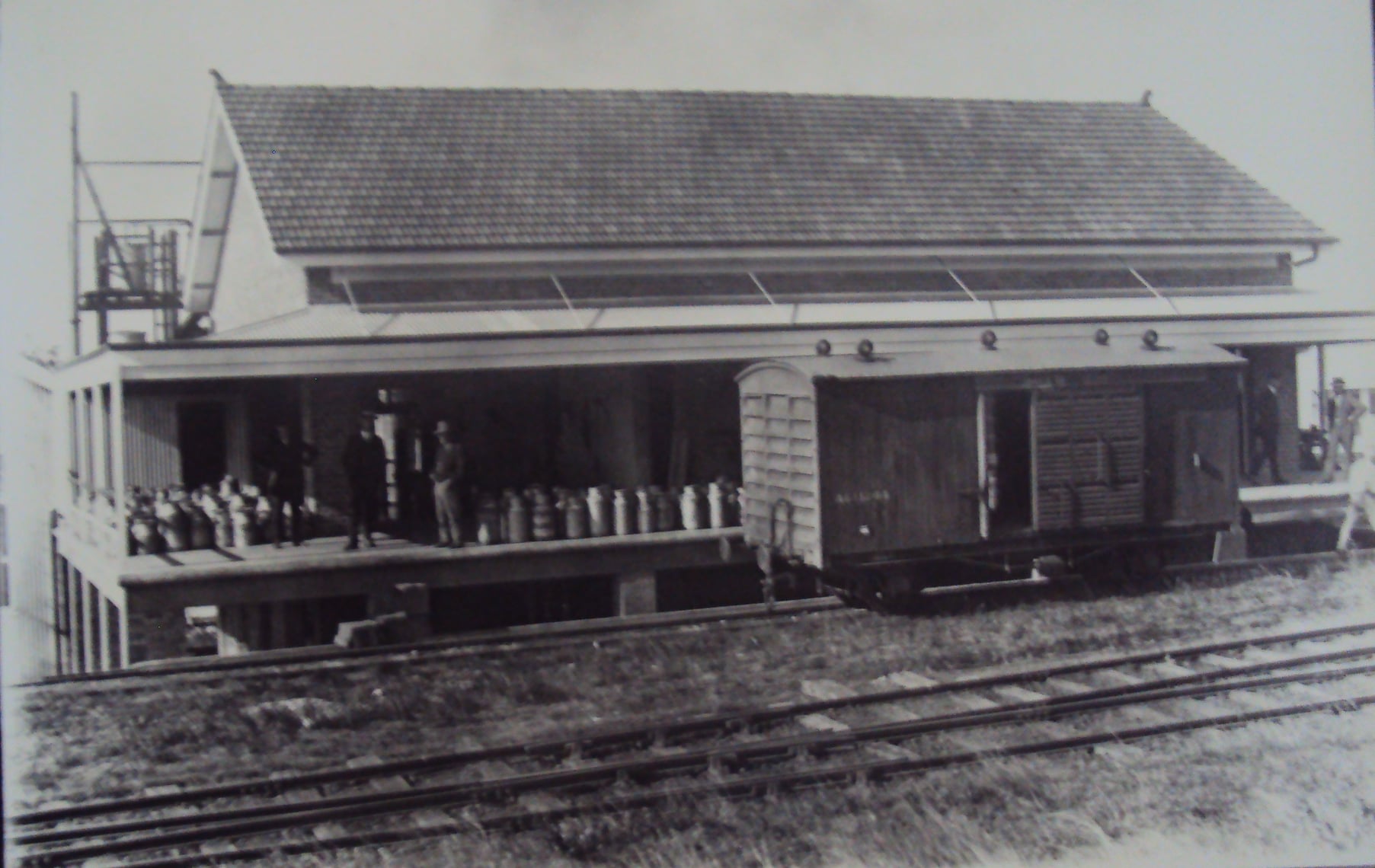
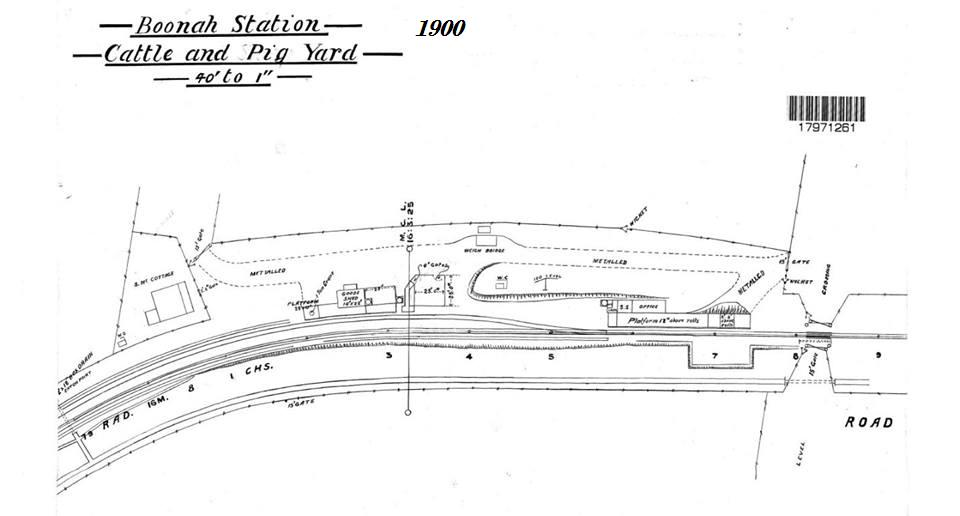
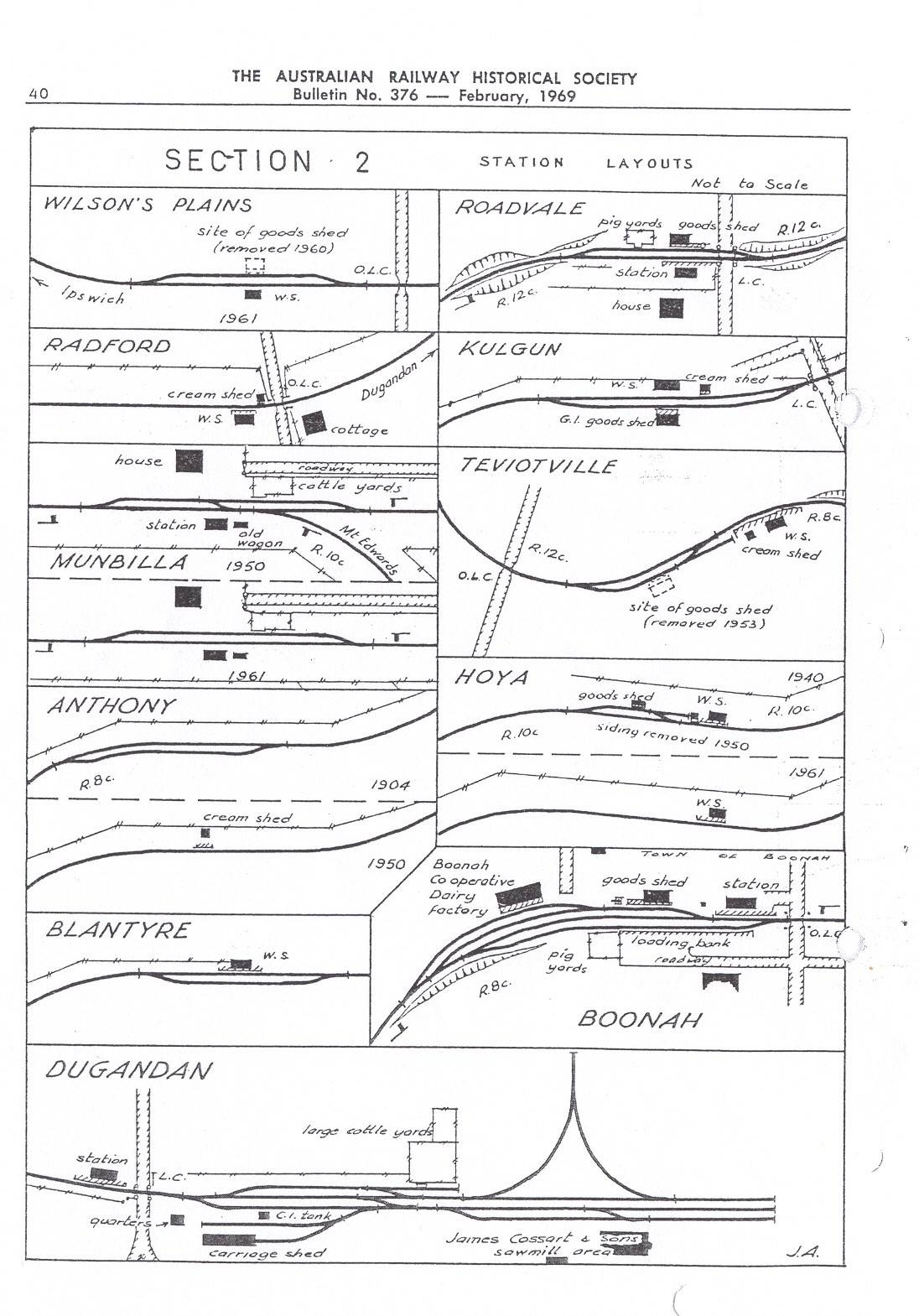
A major historical event that took place in the development of the Fassifern Valley, was when the railway was opened up to Boonah in 1887. The mixed goods trains carried timber from the many sawmills operating in the Fassifern region, plus live cattle, farm produce & dairy products to the Ipswich & Brisbane markets on a daily basis.
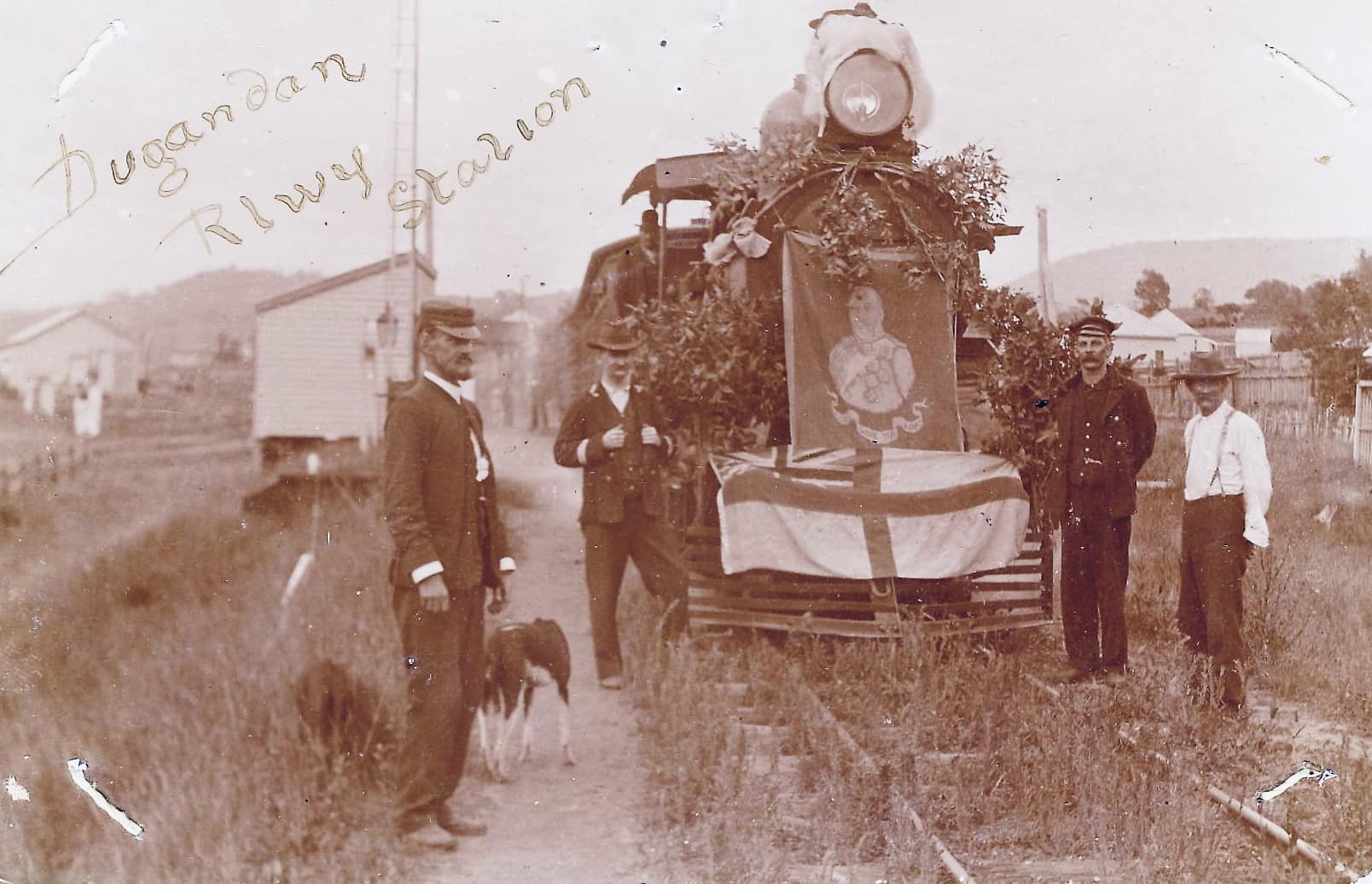
Passenger services were running each day. As kids (in the 1960s), we used to laugh about how long the train journey was – about three hours, to cover the approx 50 klm distance. But, in the late 1800s & into the 20th century, the access to rail transport made a big difference to the people of the Fassifern.

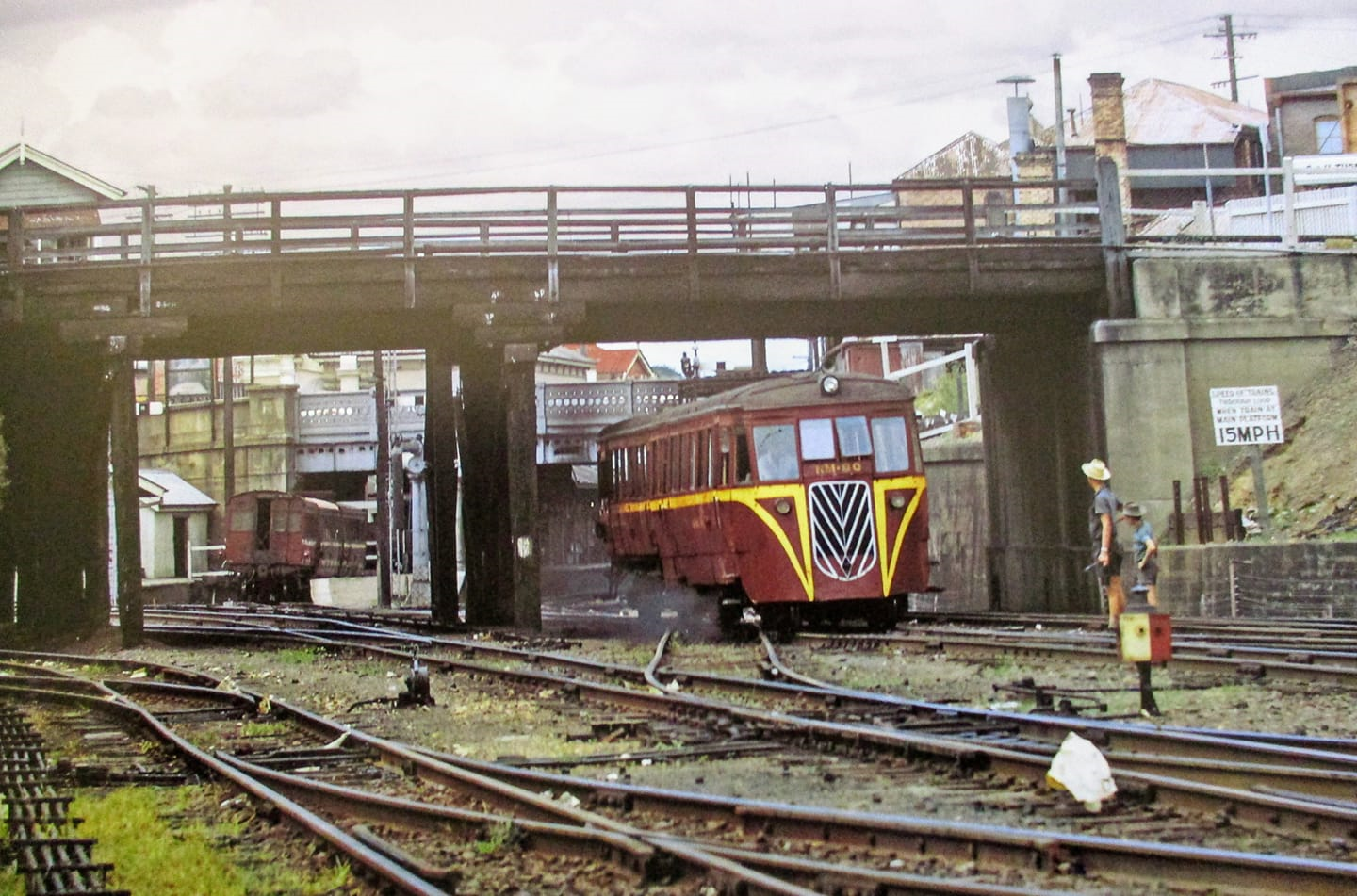
Local farmers were able to move their produce, some of it perishable, to markets much quicker than was previously available & they were in a much better positon to compete with the Darling Downs & Lockyer Valley farmers. Toowoomba (1875) & the Lockyer Valley (1865) had a rail link to the Ipswich & Brisbane markets, years earlier.
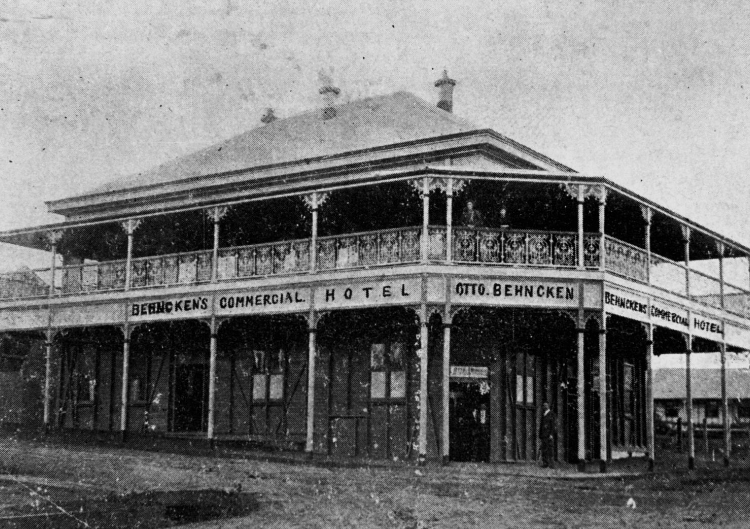
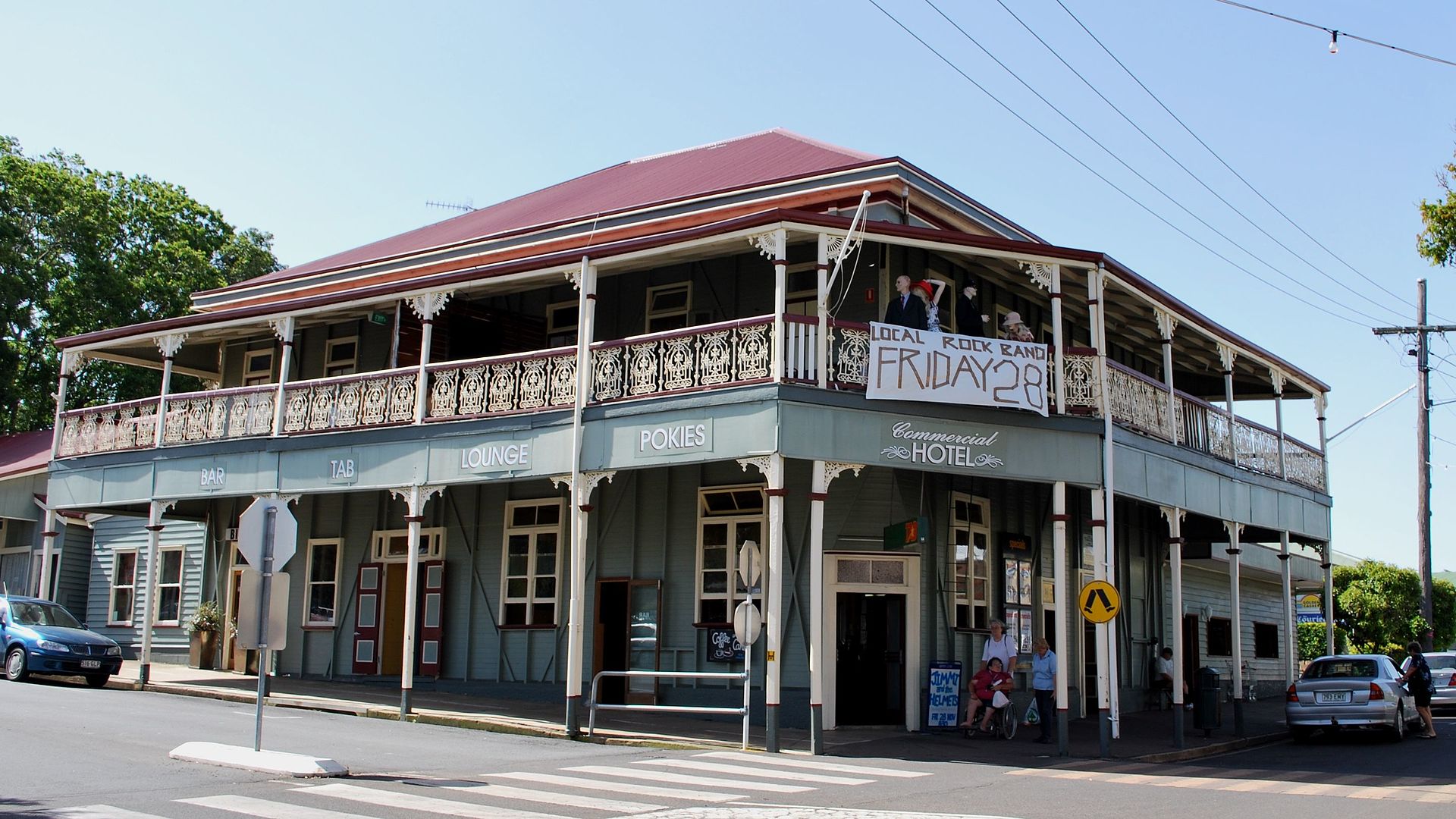
Johann Carl Streiner was the younger brother of Louisa Johanna Kubler, by two years. He also was part of the history of the Boonah & Fassifern district. In April 1905, J.C. Streiner opened his Commercial Hotel on the north-west corner of High Street and Park Street Boonah. It was a two-storey building with filigree lace balustrading on the upper verandah. Streiner had formerly operated the Royal Exchange Hotel (previously known as the Dugandan Hotel, not to be confused with the current hotel of that name in Dugandan). Carl Behncken leased and operated the new Commercial Hotel. Louisa Kubler’s brother, Johann Carl Streiner died in 1915 at Sandgate in Brisbane’s northern suburbs, aged 74.

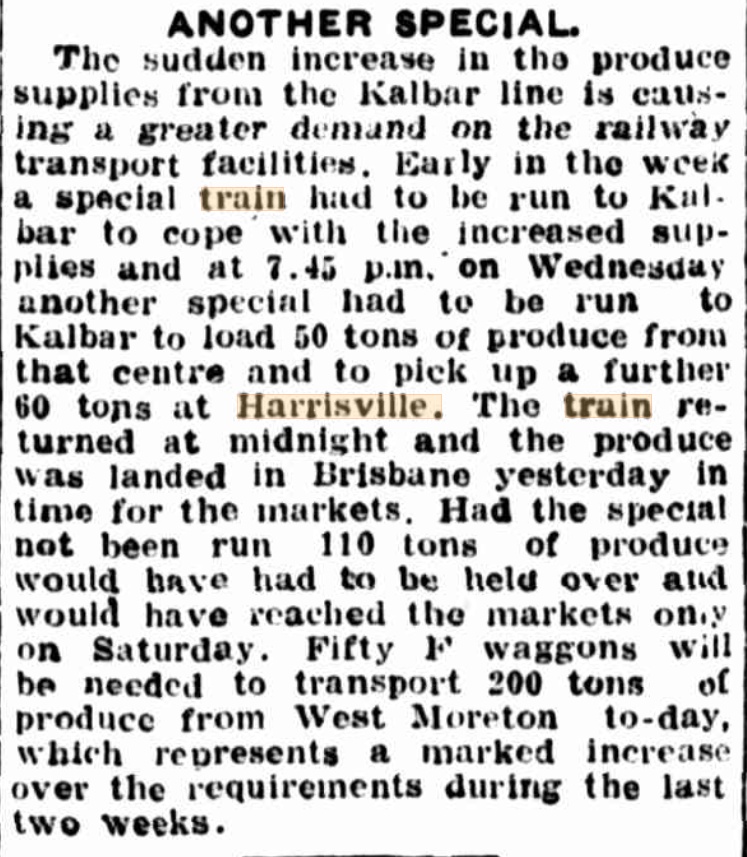
Queensland Times Sat 15 Dec 1923
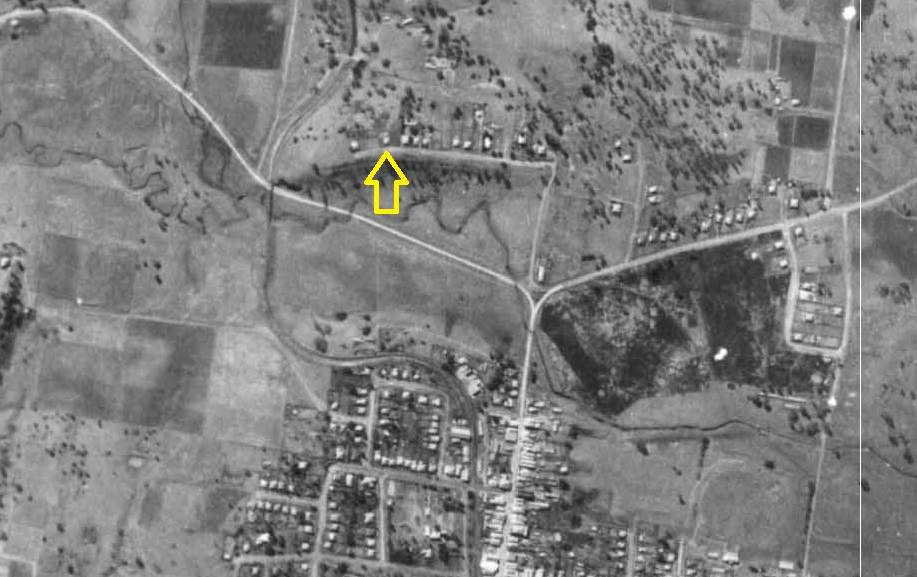
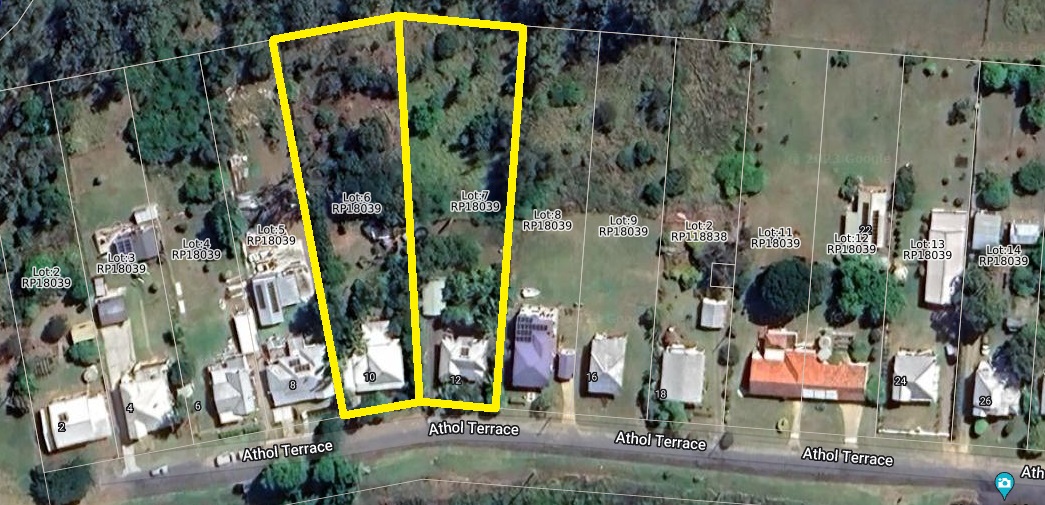
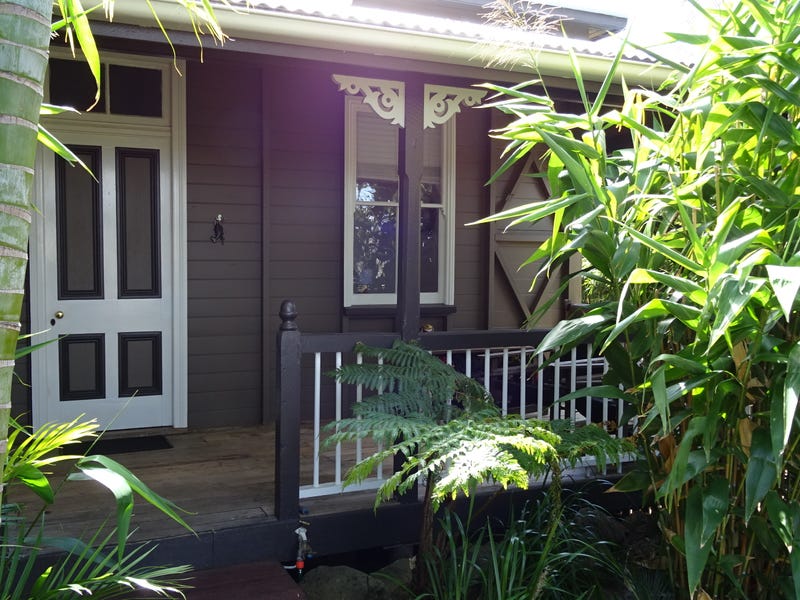
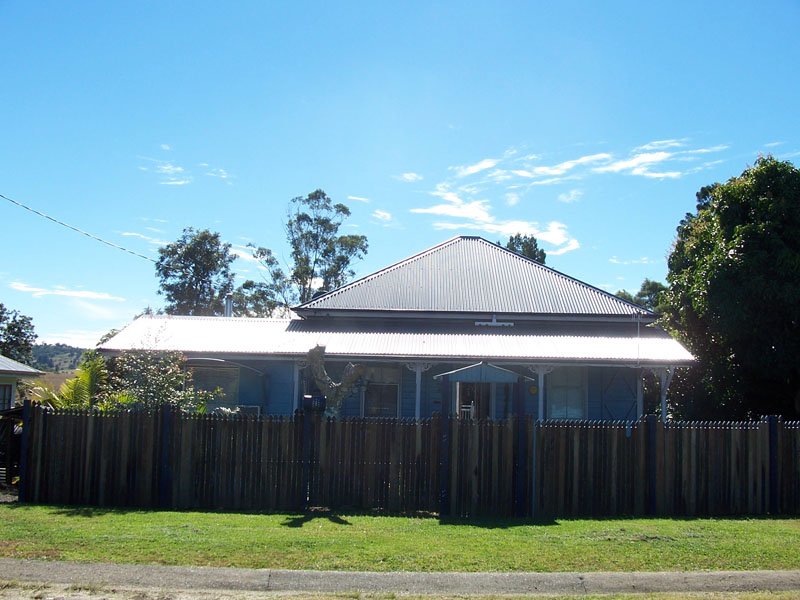
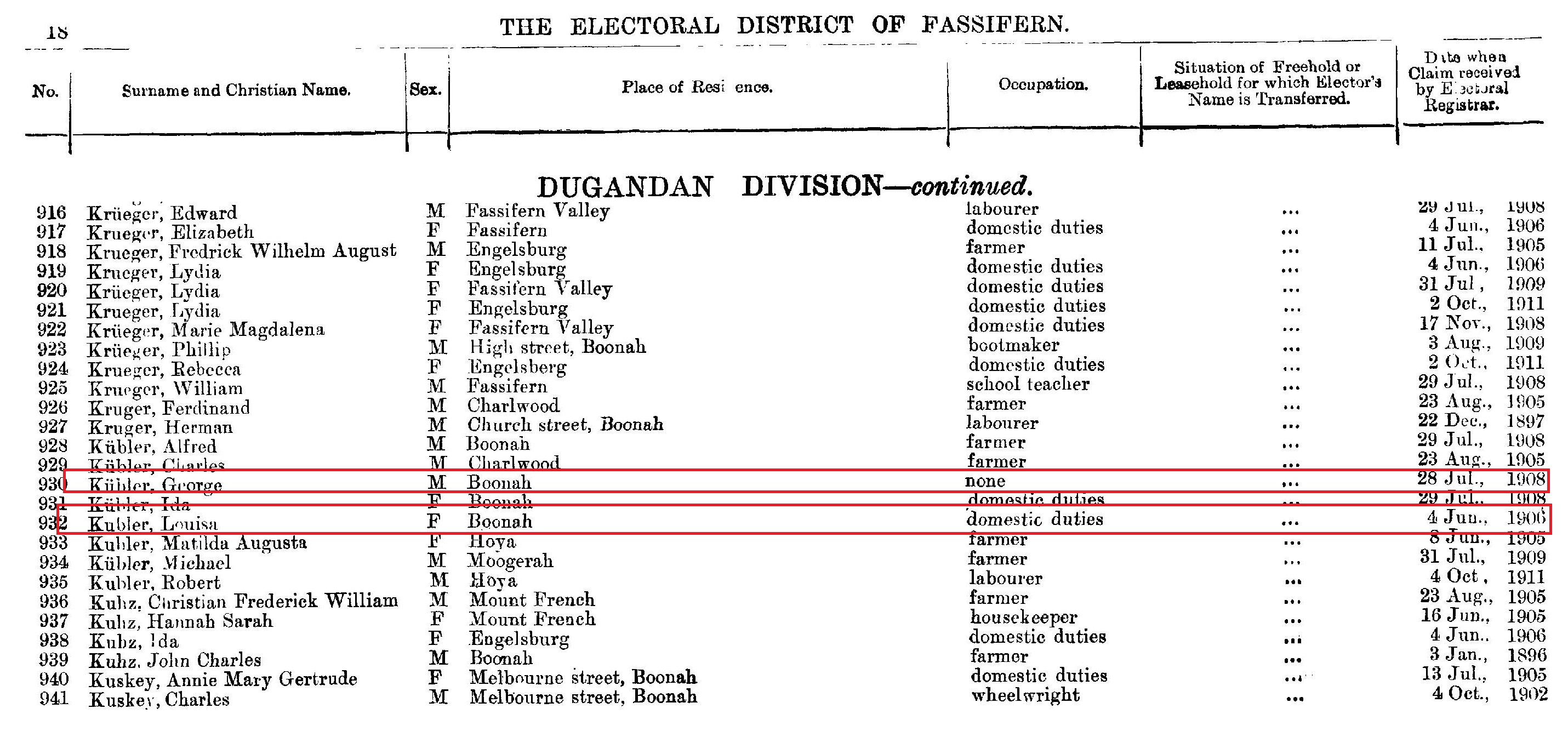
In 1908 George & Louisa retired from farming and moved to a small suburban 1 acre 1 rood block in Athol Terrace at Boonah where they lived out the rest of their lives.

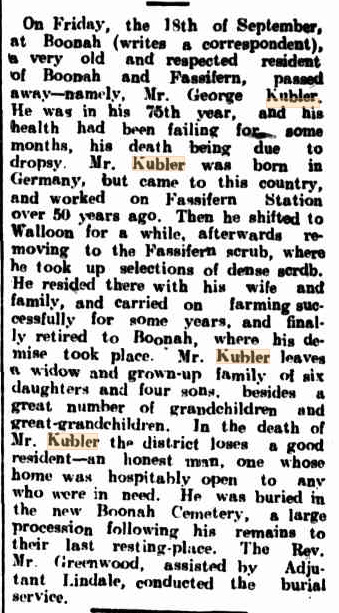
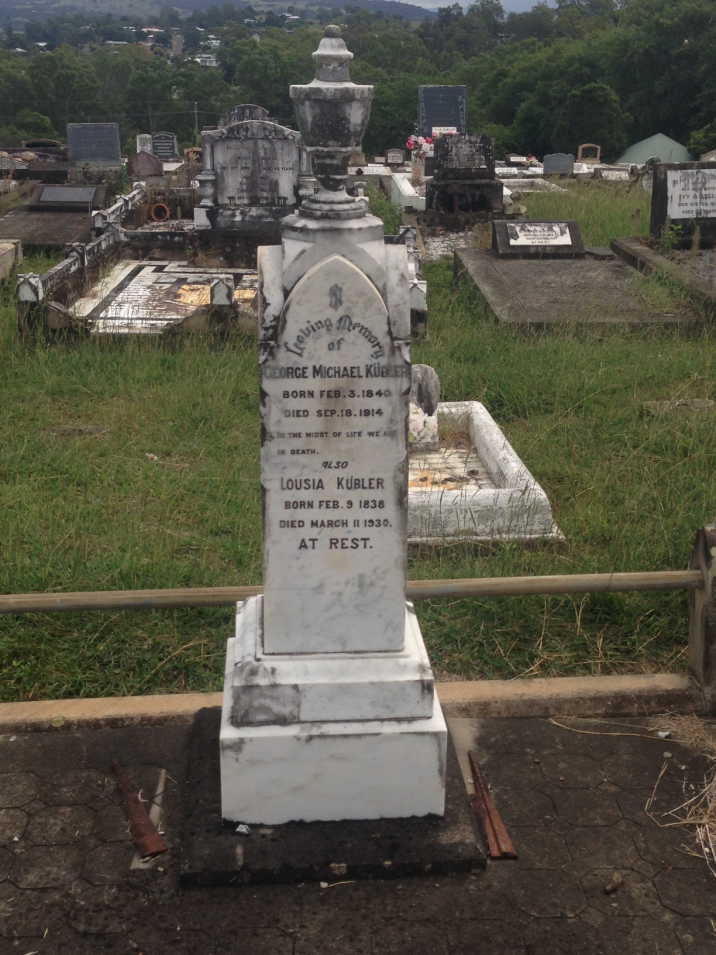
George Michael Kubler died on 18 September 1914 in Boonah Queensland at the age of 74. His death certificate shows cause of death as heart failure & exhaustion. In the death of Mr Kubler the district loses a good resident , an honest man , one whose home was hospitably open to any who were in need , he is buried at the Boonah general cemetery.

His deceased estate was valued at £248 realty & £1260 personalty.
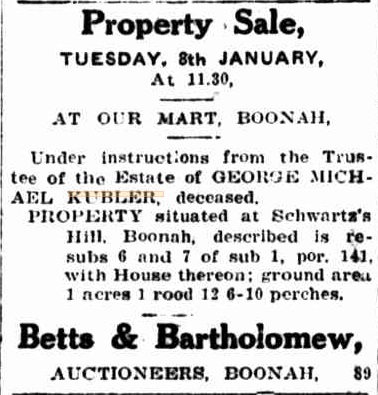
The Kubler home on Athol Terrace was put up for sale in 1923.

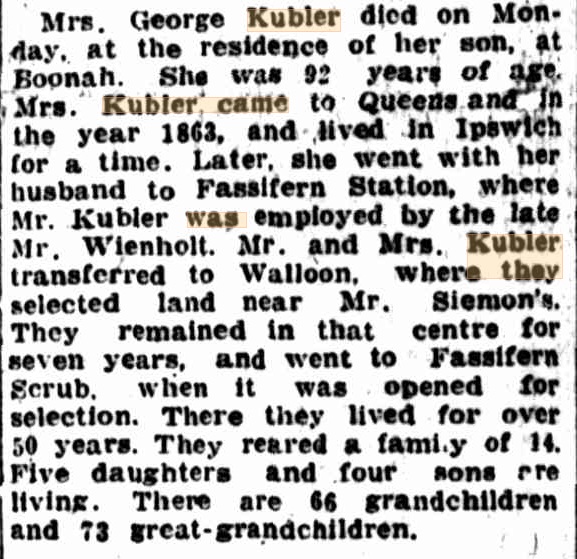
Louise Johanna Kubler died 11th March 1930 at the residence of her son at Boonah in Queensland aged 92. Her death certificate shows cause of death as heart failure, exhaustion & senile decay.
Louisa Johanna Kubler was a skilled nurse and at all hours of the night and day she would go in all weathers to attend to the sick, she could boast of having attended to over 100 maternity cases.

She was of a very kind disposition and many are the sick and needy who have blessed her for hospitality. In the last few years her health failed and she passed peacefully away.
She was laid to rest with her husband at the Boonah general cemetery.

The photo at the top of this article, courtesy of the Queensland State Library, shows Louisa wearing a bonnet & at the neck of her dress, a Salvation Army brooch. Religion played a large part in the early settlers’ lives. I’m assuming they were allied to the Lutheran Church when they first arrived in the country, 160 years ago. George & Louisa initially resided at the Lutheran Nundah Station & were married as Lutherans, while they were there. They came from a strong Lutheran area of Prussia/Germany. However, it appears that they may have diverted off that path, & joined the Salvo’s at some stage later in their lives. The Baptist, Methodist & Lutheran congregations all went through fazes when some members went their own ways & built their own churches when there were disagreements on faith & church administration. Some of the factions held more progressive belief values than the strict old German conservative parishioners. Others, like George & Louisa, probably had decided they’d had enough of the old ultra conservative religion, with its strict moral codes, that were forced upon them. The Salvation Army were a much more progressive church. I think that all of them, no matter what religion or faction they followed, understood & were happy that they were free to follow the religion of their choice, without resorting to fighting over it.
Having said all of that, they are both buried in the Methodist section at the Boonah cemetery. It will take a sharper mind than mine to work that one out😀.
Descendants of the Kublers are still living around Boonah & the Fassifern Valley, but have also branched out to many other parts of Queensland & across Australia.
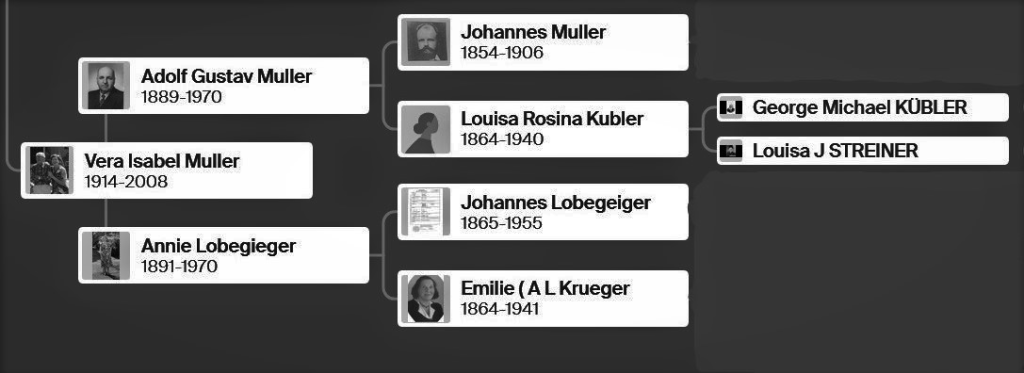
Louisa Rosina Kubler (George & Louisa Johanna Kubler’s first child) married local farmer John Muller on 26 January 1881.
Adolf Gustav Muller (John & Louisa Rosina Muller’s son) married Annie Lobegieger (from Roadvale) on 12 January 1910.
See the following article I’ve also done on Johannes (John) Mullers life & his descendants.
Their daughter Vera was my Mother. Check out the article I have done on Vera’s life here –
Since the early days of the German farming families arriving, the Fassifern Valley has become known for its high-quality vegetable produce, the majority of which goes into the nearby Brisbane markets to feed the (still increasing) South East Queensland population. Produce from the Fassifern Valley is also sent throughout Australia & exported into South East Asian markets.
The original Kublers – George & Louisa (Streiner) – came to Australia, 160 years ago, to escape Germany & to make a new life for themselves. Hard work & a refusal to give up, was their recipe to succeed.
All of our Fassifern Valley, family ancestors (Kubler’s, Muller’s, Lobegeiger’s, Krueger’s & Corcoran’s) who originally settled the district would be proud of the legacies they left for the generations that followed.
Geoff Bermingham


 porsche91722